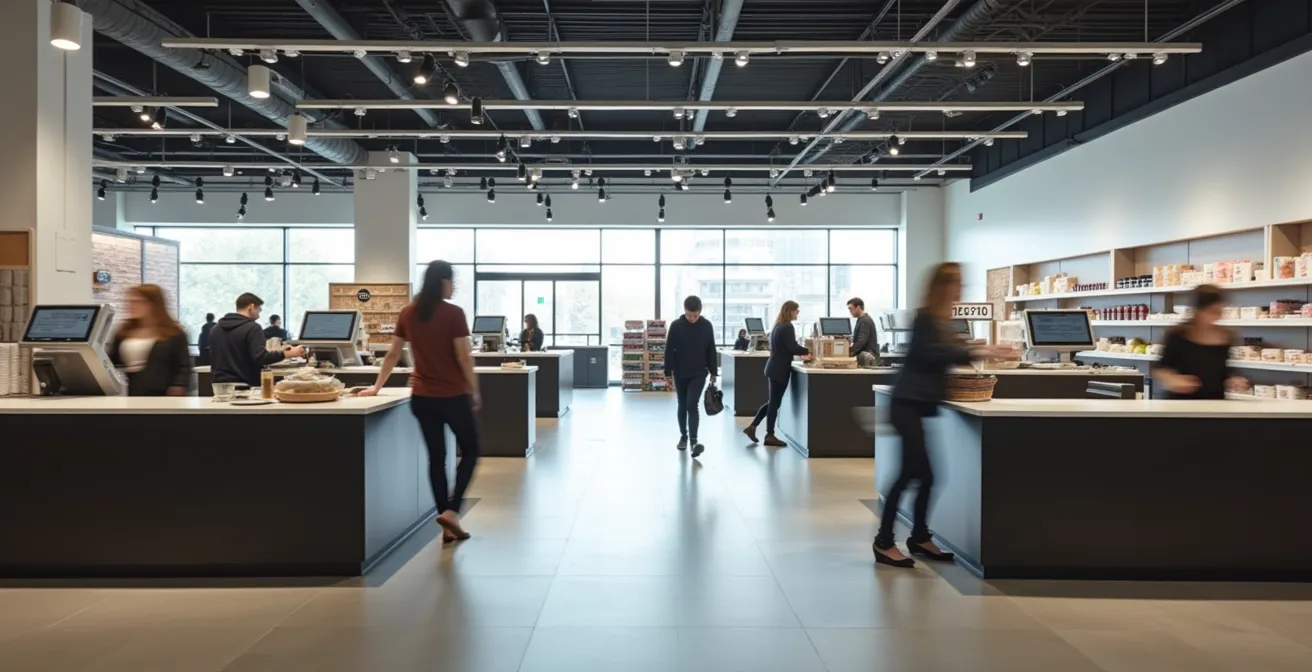
Increasing daily transactions by 15% isn’t about rushing customers; it’s about smart, systematic design of your entire store experience.
- Optimizing service time and engineering a frictionless checkout flow directly boosts sales volume, especially during peak hours.
- Training your team in conversational upselling and actively pursuing corporate accounts unlocks powerful, high-margin revenue streams.
Recommendation: Start by analyzing your profitability matrix. Identify your high-volume, high-margin products and make them the absolute focus of your new sales velocity strategy.
As a store manager, you live and die by the numbers. But what if the single most important metric you’re tracking isn’t just total revenue, but the speed at which you generate it? This is sales velocity. It’s the engine of your business, and boosting your daily transaction count is like adding a turbocharger. Many managers immediately jump to obvious tactics: run a sale, post on social media, or push staff to “just be faster.” These are short-term fixes, not a sustainable strategy.
The common advice often misses the point. It treats the symptom—a low transaction count—without diagnosing the underlying disease: friction. Friction in your service line, friction in your team’s sales approach, friction in your store’s layout. The real challenge isn’t just about making things faster; it’s about making the entire customer journey smoother, more intuitive, and more profitable at every single touchpoint. It’s about turning efficiency into an experience.
So, forget the old playbook. What if the secret to a 15% lift in daily transactions wasn’t about pushing harder, but about designing smarter? This guide provides the formula. We’re moving beyond generic advice to give you a strategic blueprint for engineering a high-velocity sales environment. We will deconstruct the mechanics of service speed, transform your upselling process, unlock bulk orders, and turn your checkout counter into a profit center. Get ready to build a system that drives volume by design, not by chance.
This comprehensive guide is structured to give you a complete, actionable toolkit. From front-of-house tactics to back-end strategy, you’ll find everything you need to systematically increase your daily transaction volume.
Summary: The Sales Velocity Formula for a 15% Transaction Boost
- Why Shaving 30 Seconds Off Service Time Increases Lunch Rush Sales?
- How to Train Staff to Upsell Without Sounding Like Robots?
- Catering and Corporate Accounts: How to Sell Bulk Orders to Local Offices?
- The Churn Risk: Why Rushing Customers Kills Repeat Business Faster than It Builds Sales?
- How to Arrange Your Store to Encourage Impulse Buys at Checkout?
- How to Accelerate Your Path to Profitability by 3 Months?
- How to Rank in the “Google Map Pack” for Keywords Near You?
- Customer Retention: How to Get Your Best Clients to Visit One More Time per Month?
Why Shaving 30 Seconds Off Service Time Increases Lunch Rush Sales?
Think about your busiest hour—the lunch rush, the after-work surge. In these moments, time isn’t just money; it’s the entire game. Every second you save per transaction is a second you can invest in the next customer. Shaving just 30 seconds off average service time doesn’t sound like much, but over 60 customers, that’s an extra 30 minutes of selling time you’ve just created out of thin air. This is the essence of Service Velocity: turning operational efficiency directly into revenue.
The pressure is real because customer patience is at an all-time low. Waiting in line is no longer a minor inconvenience; it’s a major point of friction that drives customers away. In fact, recent consumer research reveals a 126% increase in customer frustration with waiting. When a potential buyer sees a long queue, they don’t just see a wait; they see a reason to go to your competitor. By optimizing your process, you’re not just serving people faster; you’re capturing sales that would have otherwise walked out the door.
So, how do you engineer this speed? Start by deconstructing your service process into micro-steps. Where are the bottlenecks? Is it the payment terminal? The time it takes to package an item? The conversation at the register? Implement strategies to manage perceived wait time. For instance, using digital menus or in-queue displays can occupy customers, making the wait feel shorter. Some businesses even find success with virtual queue systems, allowing customers to browse (and make additional purchases) while they wait for their turn. The goal is a frictionless flow that keeps the line moving and the register ringing.
How to Train Staff to Upsell Without Sounding Like Robots?
“Would you like to add fries to that?” We’ve all heard the robotic, uninspired upsell. It feels forced, annoys the customer, and rarely works. True upselling isn’t a script; it’s a conversation. It’s about transforming your team from order-takers into trusted advisors. When done right, this approach is incredibly powerful. For example, in the restaurant industry, restaurants focusing on upselling can boost revenue by 10-15% per table. The same principle applies to any retail environment.
The key is to shift the mindset from “selling more” to “serving better.” A successful upsell should feel like a genuine recommendation that enhances the customer’s purchase. This is Conversational Upselling. It requires your staff to listen to the customer, understand their needs, and then suggest a product that genuinely complements their initial choice. Are they buying a gift? Suggest gift wrapping. Are they buying a coffee? Mention the new pastry that pairs perfectly with it. This approach builds trust and makes the customer feel understood, not targeted.
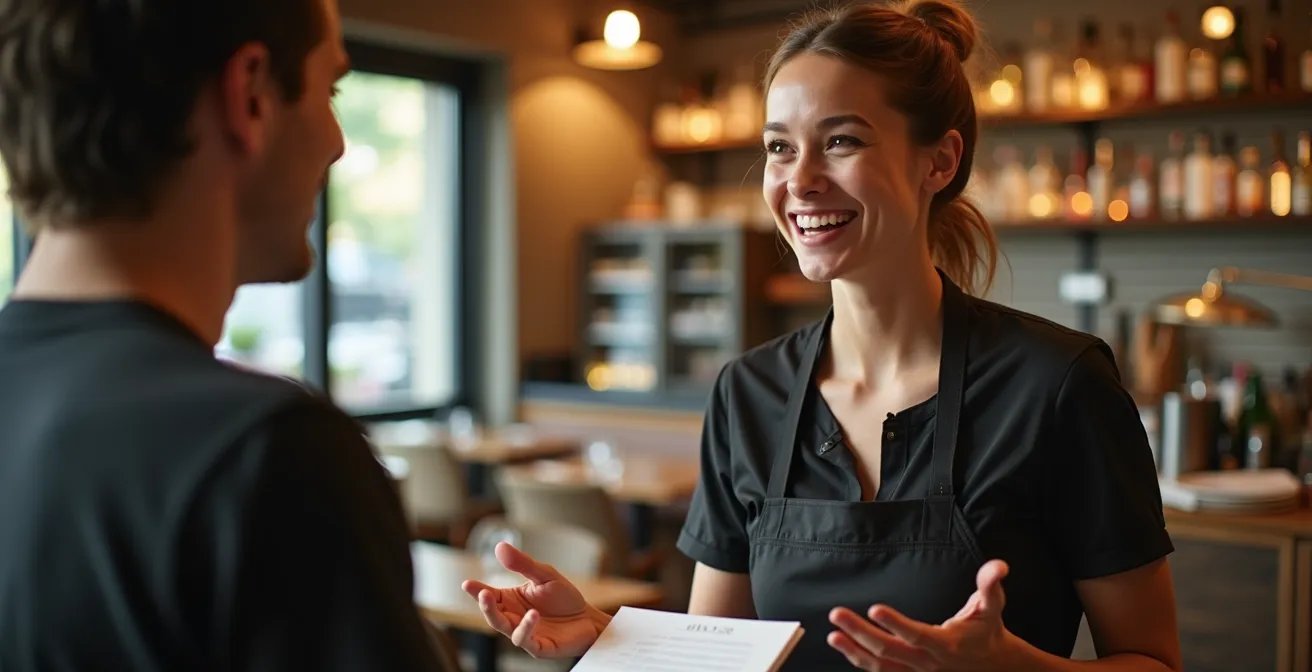
As you can see, genuine enthusiasm and expertise are far more persuasive than any script. To cultivate this skill, you need to make training engaging. Move away from boring manuals and gamify the process. Create role-playing competitions where team members practice describing products in enticing ways. Run team-based daily challenges with group rewards to foster a collaborative selling culture. By making it a fun, competitive, and rewarding experience, you empower your staff to develop the confidence and product knowledge needed for authentic, effective upselling.
Catering and Corporate Accounts: How to Sell Bulk Orders to Local Offices?
Increasing daily transaction counts isn’t just about more individual customers; it’s about bigger, higher-value transactions. Tapping into the local B2B market by offering catering and corporate accounts is one of the fastest ways to inject significant revenue. A single corporate lunch order can be worth 20, 30, or even 50 individual sales. This is a classic “work smarter, not harder” strategy to boost your sales velocity.
The challenge is getting your foot in the door. Cold calling office managers is inefficient. A far more effective strategy is to leverage your existing customer base. One of the most successful tactics is creating a formal B2B referral program. This transforms your satisfied clients into a lead-generation engine. The concept is simple: offer significant credits or personal gift cards to office managers for every new corporate account they refer. This creates a powerful incentive and automates a steady stream of high-quality leads.
Case Study: The B2B Referral Engine
Successful restaurants and cafes are implementing formal B2B referral programs. Instead of just hoping for word-of-mouth, they offer office managers tangible rewards, such as a $50 credit on their next order or a personal gift card, for each new corporate client they bring in. This has proven to be a highly effective method for automating lead generation, leveraging the trust built with existing satisfied corporate customers to open doors at neighboring businesses.
To approach this market, you need a clear strategy. Different tactics work for different targets. A high-end eatery might offer curated sample boxes to executives, while a fast-casual spot could offer a “Trojan Horse” discount—a steep first-time order discount—to win over a whole office. The table below compares some common approaches.
| Strategy | Initial Investment | Conversion Rate | Best For |
|---|---|---|---|
| Sample Box Program | High ($50-100 per box) | 35-45% | Premium restaurants targeting executives |
| Trojan Horse Discounts | Low (discount only) | 20-25% | Fast-casual targeting employees |
| Catering Champion Kits | Medium ($20-30 per kit) | 25-30% | All restaurant types |
The Churn Risk: Why Rushing Customers Kills Repeat Business Faster than It Builds Sales?
In the quest for speed, there’s a dangerous trap: confusing efficiency with rushing. While optimizing your process to be faster is crucial, making a customer *feel* rushed is a fatal error. This is the critical paradox of sales velocity. Pushing a transaction through 10 seconds faster might gain you a tiny bit of time, but if it creates a negative experience, you’ve likely lost that customer’s future business forever. The short-term gain is obliterated by the long-term loss.
This is where the concept of Service Velocity must be handled with care. It’s not about a one-size-fits-all pace; it’s about matching your speed to the customer’s intent. The person grabbing a quick coffee on their way to work wants speed and has low-touch needs. The family browsing for a special occasion wants attention, advice, and a high-touch experience. Treating them the same is a recipe for disaster. Rushing the family makes them feel unimportant, while slowing down the commuter frustrates them. Both are less likely to return.
So, how do you find the perfect balance? You need to measure and listen. The first step is to implement systems to capture real-time feedback. Simple one-tap feedback tools at the point of sale can give you an immediate pulse on customer satisfaction. You can then correlate this data with your transaction speed. You might discover your “sweet spot” is a 90-second transaction time, but that satisfaction plummets once you drop below 60 seconds. This data is gold.
Train your staff to read verbal and non-verbal cues to segment customers on the fly. Does the customer have headphones in and their credit card out? That’s a low-touch, high-speed signal. Are they asking questions and looking at different options? That’s a high-touch, slower-pace signal. By adapting your service style to these cues, you can be efficient without ever making a customer feel like a number.
How to Arrange Your Store to Encourage Impulse Buys at Checkout?
Some of your most profitable sales happen in the final moments of the customer journey: the impulse buy at the checkout. This isn’t an accident; it’s a science. A significant portion of consumer spending is unplanned, with studies showing that impulse buying accounts for between 40-80% of all purchases. As a manager, your job is to create an environment that actively encourages these spontaneous decisions. This is what we call Engineered Impulse.
The secret lies in strategic product placement within high-traffic “power zones.” Your single most powerful zone is the area surrounding your checkout counter. While customers are waiting to pay, they are a captive audience. This is your prime real estate for placing low-cost, high-margin items that are easy to grab. Think small treats, useful accessories, or travel-sized versions of popular products. The goal is to present a solution to a problem they didn’t even know they had until they saw it.

Effective merchandising in this zone is all about creating a “discovery” moment. As the image shows, focus on items with interesting textures, colors, and packaging. Group complementary products together. The key is to make the display visually appealing and easy to navigate. Don’t overwhelm with clutter; instead, curate a selection of irresistible items. Rotate the products regularly to keep the display fresh and give repeat customers a reason to look again. By turning your checkout into a final point of engagement, you add another layer of profitability to every transaction.
How to Accelerate Your Path to Profitability by 3 Months?
Boosting transaction volume is exciting, but it’s only half the battle. The ultimate goal is profitability. In a market where the NRF forecasts that retail sales for 2024 will experience 2.5-3.5% growth, you need to be smarter and more strategic than your competitors to capture a meaningful share. Accelerating your path to profitability means focusing your newfound sales velocity on the products that make you the most money.
Not all sales are created equal. A high-volume sale of a low-margin item might look good on your transaction counter, but it does little for your bottom line. The key is to analyze your sales data through the lens of a Profitability Matrix. This simple tool helps you categorize every product based on two simple axes: its sales volume and its profit margin. This immediately reveals where you should be focusing your energy.
This analysis provides a clear action plan. Your “High Volume/High Margin” products are your superstars—they deserve prime positioning and aggressive promotion. “High Volume/Low Margin” items are workhorses; your strategy here should be to bundle them with high-margin accessories to increase the total profit per transaction. “Low Volume/High Margin” items are hidden gems; they are perfect candidates for targeted conversational upselling by your trained staff. And “Low Volume/Low Margin” products? They are likely candidates for discontinuation, freeing up valuable shelf space and capital.
The following matrix gives you a framework for this analysis. Apply it to your own product catalog and let the data guide your strategy.
| Product Category | Sales Volume | Profit Margin | Priority Action |
|---|---|---|---|
| High Volume/High Margin | Top 20% | >40% | Aggressive promotion, prime positioning |
| High Volume/Low Margin | Top 20% | <20% | Bundle with high-margin items |
| Low Volume/High Margin | Bottom 50% | >40% | Targeted upselling to specific segments |
| Low Volume/Low Margin | Bottom 50% | <20% | Consider discontinuation |
How to Rank in the “Google Map Pack” for Keywords Near You?
In today’s market, your digital storefront is just as important as your physical one. For any local business, winning a spot in the “Google Map Pack”—the top three local listings in a search result—is like having a giant, flashing neon sign pointing directly at your door. This is where your highest-intent customers are looking. They aren’t just browsing; they are ready to buy, right now. Optimizing your Google Business Profile (GBP) is a non-negotiable part of driving transaction volume.
To do this effectively, you must think like your customer. They aren’t just searching for “[Your Business Name].” They’re searching for solutions to immediate problems. This means targeting long-tail intent keywords like “quick lunch near me,” “last-minute gift shop open now,” or “coffee shop with fast wifi.” Your GBP profile, from your business description to your customer reviews, needs to be saturated with these terms.
Here are four powerful tactics to optimize your GBP for sales velocity:
- Create “Flash Sale” Google Posts: Use the Posts feature to announce time-sensitive offers (e.g., “20% off all sandwiches, today 2-4 PM only!”). This creates urgency and drives immediate foot traffic from people browsing on Google Maps.
- Target High-Intent Keywords: Go beyond generic terms. Focus your description and services on keywords that signal speed and convenience, like “express checkout,” “curbside pickup,” or “ready in 5 minutes.”
- Engineer Keyword-Rich Reviews: Don’t just ask for a review. Prompt your happiest customers with specific questions: “Did you appreciate how quick our service was today?” or “Tell us about your fast checkout experience!” This naturally seeds your reviews with velocity-related keywords.
- Update Your Business Attributes: Regularly check your GBP attributes to highlight features that appeal to customers in a hurry. Ticking boxes like “In-store pickup” or “Quick visit” can make you stand out in searches.
This data-driven approach allows you to be incredibly precise. Instead of just hoping for local traffic, you can pinpoint exactly where your high-velocity products are most popular, as one case study highlights, you can tell partners, “Here are the exact zip codes where my product does well… and here are the average weekly sales in those zip codes.” This level of detail is a game-changer.
Key takeaways
- Optimize service time to reduce customer friction and capture rush-hour sales.
- Implement conversational upselling and targeted corporate outreach to open new revenue channels.
- Design your store layout to engineer impulse buys and use data-driven strategies to retain your best customers.
Customer Retention: How to Get Your Best Clients to Visit One More Time per Month?
Acquiring a new customer is expensive. Retaining an existing one is pure profit. Your most valuable asset isn’t your inventory; it’s your base of loyal, repeat customers. The simplest way to boost your transaction count is to persuade your best clients to visit just one more time per month. This strategy focuses your energy on the people who already love what you do, making it one of the highest-ROI activities you can undertake.
A key, often overlooked, driver of customer loyalty is staff morale. A happy, motivated team provides the kind of positive, memorable service that keeps customers coming back. The data is clear: motivated employees are 87% less likely to leave, leading to a more experienced, consistent, and expert team. This stability directly translates into a better customer experience and, therefore, higher retention rates.
To achieve that “one extra visit,” you need to move beyond generic loyalty cards and implement a predictive retention strategy. This means using your sales data to understand customer behavior and intervene *before* a loyal customer churns. It’s about being proactive, not reactive. You need to identify your top 20% of customers and treat them like VIPs, making them feel seen and valued in a way that your competitors don’t.
Your Audit Checklist: Boosting Client Visit Frequency
- Points of Contact: List all channels where you interact with customers (in-store, email, social media, your app) and assess how each contributes to retention.
- Collecte: Inventory your existing loyalty perks. Are they generic (e.g., “10% off”) or personalized and valuable to your best clients?
- Cohérence: Confront your perks with your brand positioning. Do your rewards for top clients reflect their high value, or are they the same discounts you offer everyone?
- Mémorabilité/Emotion: Identify ‘surprise and delight’ opportunities versus purely transactional rewards. Where can you create a memorable, emotional connection?
- Plan d’intégration: Prioritize one proactive retention tactic. For example, set up an automated “we miss you” email with a special offer for a top customer who hasn’t visited in their usual timeframe.
Stop leaving money on the table. The principles of sales velocity aren’t just theory; they are a practical, powerful toolkit for any store manager ready to drive real growth. Start by implementing just one of these strategies today—analyze your profitability matrix, gamify your upselling training, or redesign your checkout counter—and watch your daily transaction count begin its climb.