
Stop trying to ‘fix’ your 4.2 rating; instead, treat it as a powerful diagnostic tool for your hotel’s operational health.
- Negative reviews are not attacks but free, high-value consulting that pinpoints specific failures in the customer experience.
- Proactively managing reviews transforms your business from being reactive to customer complaints into a system that anticipates and solves issues.
Recommendation: Shift your focus from chasing a higher score to building an operational feedback loop that uses review data to drive improvements, which will naturally and sustainably lift your rating to 4.8 and beyond.
As a hotel franchisee, seeing a competitor with a 4.8-star rating capture bookings that should be yours is deeply frustrating. It’s natural to feel that your 4.2 rating is an unfair mark that doesn’t reflect the hard work you and your team put in daily. The common advice is to simply “get more reviews” or “respond to negative feedback,” but these are just pieces of a much larger puzzle. This reactive approach often feels like a constant, uphill battle against an ever-changing score.
The truth is, your rating isn’t a score to be fixed; it’s a symptom. It’s a lagging indicator of your hotel’s operational health. But what if, instead of viewing that 4.2 as a problem, you saw it as a powerful diagnostic tool? The key to moving from 4.2 to 4.8 isn’t about gaming the system or begging for 5-star reviews. It’s about building a robust, operational feedback loop that systematically listens to what customers are telling you, turns those insights into tangible improvements, and closes the loop to foster loyalty and advocacy.
This guide will walk you through building that system. We won’t just cover how to ask for a review; we’ll show you when and how to ask for maximum impact. We will reframe the “art of the apology” from a damage-control tactic into a public display of accountability that wins back customers. We’ll explore how to transform your review profile into a powerful local SEO asset and defend it from bad actors. Ultimately, you’ll learn to build a reputation flywheel that not only elevates your rating but also drives customer retention and long-term value.
This article provides a structured approach to transforming your online reputation from a source of stress into a driver of growth. The following sections break down the essential components of this operational system.
Summary: From 4.2 Stars to a System for Dominance
- The Ask: Scripting Your Staff to Request Reviews Without Being Pushy
- The Art of the Apology: Turning a 1-Star Rant into a Loyal Customer Publicly
- Keywords in Reviews: How to Encourage Customers to Mention Specific Services for SEO Benefit?
- The Attack: How to Spot and Report Fake Reviews from Competitors or Bots?
- Reading Between the Stars: Using AI to Analyze What Customers Are Really Saying in Text
- The Review Gate: Why Pre-Screening Customers for Reviews Can Get You Banned by Google?
- Mystery Shopper vs Corporate Auditor: Who Sees the Real Customer Experience?
- How to Build a Retention Loop That Increases Customer Lifetime Value by 30%
The Ask: Scripting Your Staff to Request Reviews Without Being Pushy
The most common mistake in review generation is asking everyone, all the time. A more effective strategy is to empower your staff to identify the “peak delight moment”—that specific point in the customer journey where satisfaction is highest. For a hotel, this could be after a seamless check-in, when a guest praises the room’s cleanliness, or after a concierge successfully secures a difficult dinner reservation. This is the moment a review request feels like a natural extension of great service, not an awkward imposition.
To do this, you must shift from a generic “please review us” script to a system of conversational priming. Train your team to listen for positive cues. When a guest expresses happiness, the staff member can respond with, “I’m so glad you’re enjoying your stay! Feedback from happy guests like you helps others find us. If you have a moment later, we’d be grateful for a review.” This approach is personal, non-pushy, and highly effective. As smart businesses have found, systematic processes like this can achieve a 35-50% review success rate among satisfied customers, a massive jump from the typical 2-5% seen with no system at all.
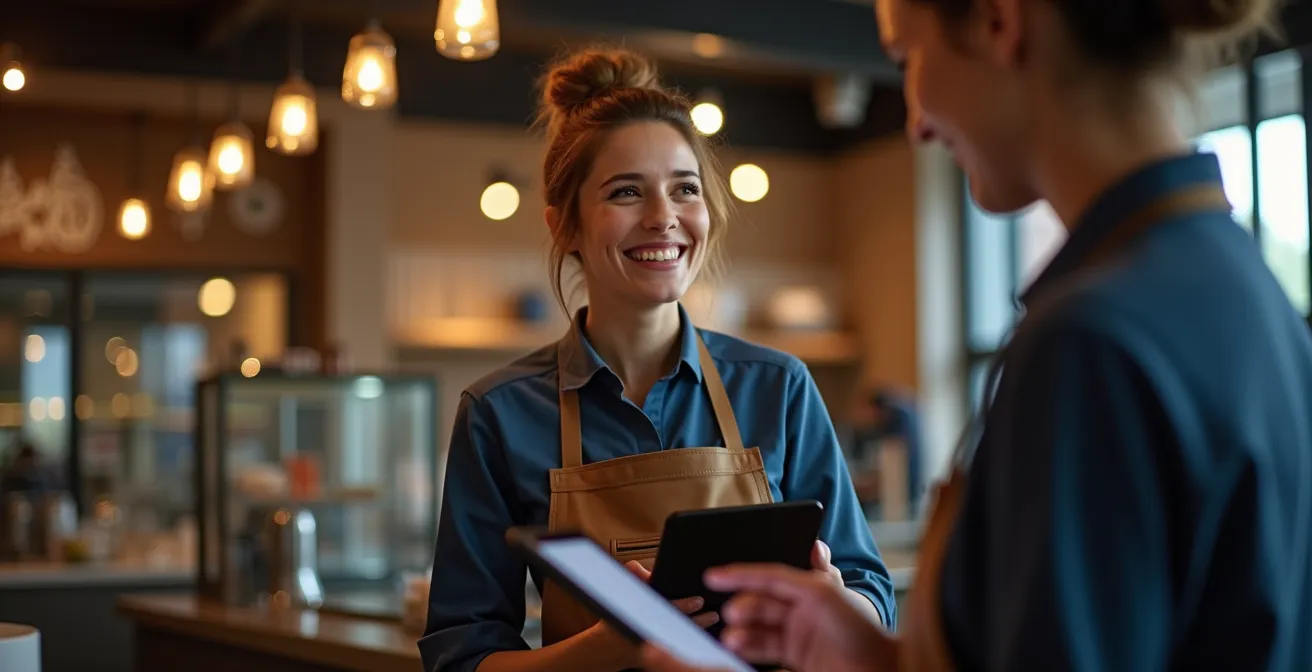
As you can see, the interaction is human-centric. The goal isn’t just to get a review, but to validate the guest’s positive experience and make them feel heard. Combining staff training with tools like QR codes or shareable links at the front desk makes the process frictionless for the guest. It turns a transactional request into a relational moment, significantly increasing the likelihood of receiving a detailed, positive review.
Ultimately, a successful ‘ask’ is not about a perfect script but about creating a culture where staff are attuned to customer happiness and empowered to act on it.
The Art of the Apology: Turning a 1-Star Rant into a Loyal Customer Publicly
A 1-star review can feel like a public attack, but viewing it through a strategic lens reveals a golden opportunity. A negative review is not just a complaint; it is a detailed, free report on a failure within your customer experience. Your public response is your chance to demonstrate accountability, professionalism, and a genuine commitment to service excellence. This is critical, as research shows that 88% of consumers trust a business more when it responds to all reviews, compared to just 47% when it responds to none.
A defensive or generic “we’re sorry for your experience” is worse than no response at all. The goal is to de-escalate the situation publicly and resolve it privately. By acknowledging the specific issue, expressing a sincere apology, and providing a direct line to management to fix the problem, you show both the unhappy guest and all future prospects that you take feedback seriously. This two-step process—public acknowledgment followed by private resolution—is the cornerstone of turning a detractor into a potential advocate.
Once the issue is resolved offline to the customer’s satisfaction, a brief follow-up public reply can close the loop, showcasing your commitment. For example: “Update: John, thank you again for speaking with our manager. We’re glad we could resolve this for you.” This simple act transforms a negative mark into a powerful testament to your hotel’s integrity.
Your Action Plan: The Professional Negative Review Response Framework
- Acknowledge Promptly: Respond to the review publicly within 24-48 hours to show you are attentive and engaged.
- Apologize Genuinely: Express a sincere apology for the specific failure in their experience. Avoid defensive language or excuses.
- Take it Offline: Provide a dedicated email address or phone number for a manager to demonstrate a high-level commitment to resolving the issue.
- Resolve Privately: Work directly with the customer to understand the full context and find a satisfactory solution. This is where you fix the root problem.
- Post a Public Follow-Up: After a successful resolution, add a brief public update to your original reply to show accountability and closure to all readers.
This transparent process does more than just mitigate damage; it builds a level of trust that a flawless review profile never could.
Keywords in Reviews: How to Encourage Customers to Mention Specific Services for SEO Benefit?
Reviews are more than just stars; they are a critical source of keyword-rich content that directly influences your hotel’s visibility in local search. When customers naturally mention specific amenities or services—like “pet-friendly rooms,” “rooftop pool,” or “complimentary breakfast”—they are feeding Google’s algorithm exactly what it needs to understand your business’s core offerings. In fact, if your reviews consistently mention a keyword, the likelihood that your Profile will get a Review justification in search results increases significantly.
Google’s AI even uses concepts from reviews to generate business summaries. While you can’t edit these summaries directly, you can influence them. This is where conversational priming at the point of service becomes an SEO tool. For instance, at checkout, a front desk agent might say, “We hope you enjoyed our newly renovated fitness center.” This simple sentence plants the phrase “fitness center” in the guest’s mind, making it more likely to appear in their review.
You can also tailor your automated review request messages based on the services a guest used. If they booked a spa package, the email can be customized: “We’d love to hear about your experience, especially your thoughts on your recent spa treatment.” This gentle nudge encourages the use of highly relevant, long-tail keywords that potential customers are searching for. This strategy doesn’t just improve your ranking for those terms; it also provides social proof that your hotel excels in those specific areas, making your listing more compelling and clickable.
This turns every piece of customer feedback into a small but cumulative boost to your discoverability, helping you outrank competitors for the services that matter most.
The Attack: How to Spot and Report Fake Reviews from Competitors or Bots?
While most reviews are genuine, a sudden flood of 1-star ratings can be a sign of a malicious attack from a competitor or bot. These fake reviews can temporarily tank your rating and damage morale. Fortunately, they often leave a trail of evidence. Learning to spot these patterns is the first step in defending your reputation. Google’s automatic spam detection is sophisticated, but manual reporting is crucial for reviews that slip through the cracks.
Fake reviews often share distinct characteristics. They are typically vague, lacking the specific details of a real customer experience (“terrible place, avoid”). The reviewer’s profile may be a red flag, often featuring a generic name with no profile picture and no other review history. A key indicator of a coordinated attack is a sudden burst of negative reviews within a 24-48 hour period, especially if they contain similar phrasing or identical grammatical errors. In some cases, they might even directly mention a competitor’s name, which is a clear violation of Google’s policies.
When you suspect a review is fake, your first step should be to cross-reference it with your internal records. Can you find a guest with that name in your CRM or booking system who stayed on or around that date? If there’s no record, it strengthens your case. To report the review:
- Navigate to the review in your Google Business Profile.
- Click the three dots and select “Report review.”
- Choose the most relevant reason (e.g., “Conflict of interest,” “Spam”).
Document everything—screengrabs, timing, and lack of customer records—as you may need it for follow-up with Google Support. While the process can take time, successfully removing fraudulent reviews is essential for maintaining an accurate and fair representation of your business.
By staying vigilant and systematic in your reporting, you ensure that your rating reflects the real experiences of your genuine customers.
Reading Between the Stars: Using AI to Analyze What Customers Are Really Saying in Text
Your 4.2-star rating is just a single data point. The real value lies in the text of the hundreds of reviews that produce that average. Manually reading every review is time-consuming and makes it difficult to spot trends. This is where AI-powered sentiment analysis becomes a game-changer. These tools go “between the stars” to analyze customer feedback at scale, categorizing comments and identifying recurring themes that would otherwise be missed.
AI-driven dashboards can highlight that while your overall rating is 4.2, mentions of “check-in process” trend negatively at 2.5 stars, whereas “pool cleanliness” trends positively at 4.9 stars. This level of granularity transforms vague feedback into a precise operational roadmap. You now know exactly where to focus your training and resources. Top-performing businesses use these insights to proactively address emerging negative themes before they snowball and significantly impact the overall rating. For example, a rising number of comments about “noisy hallways at night” can trigger a review of security patrol schedules or guest policies.
These insights also directly inform your SEO strategy by revealing which metrics have the most significant impact on your local ranking performance. Understanding the benchmarks for these factors allows you to set clear, data-driven goals for your reputation management program.
This table outlines the key review metrics that influence your visibility in the local pack and what your targets should be. As shown in this comprehensive analysis of local SEO factors, each metric plays a distinct role.
| Metric | Impact on Local SEO | Benchmark |
|---|---|---|
| Review Quantity | 15% of local pack ranking | 50+ total reviews |
| Review Velocity | Top 20 ranking factor | 2-5 reviews/week |
| Review Recency | 67% consumer influence | Within 3 months |
| Star Rating Average | Direct prominence signal | 4.0+ stars minimum |
This data-centric approach ensures your efforts are always focused on the initiatives that will have the greatest positive impact on both customer satisfaction and your bottom line.
The Review Gate: Why Pre-Screening Customers for Reviews Can Get You Banned by Google?
In the quest for a perfect 5-star rating, it can be tempting to implement “review gating.” This practice involves pre-screening customers with an internal survey and then directing only those who gave a positive rating to your public Google review page, while funneling negative feedback to a private form. While it may seem like a clever way to inflate your score, it is a direct violation of Google’s policies. It is considered a form of spam because it discourages and prohibits negative reviews, creating an inauthentic and misleading public profile.
The risks associated with review gating are severe and far outweigh any short-term benefit. If detected, Google could suspend your listing, making your business invisible in search and on maps, a potentially devastating blow for any hotel. Beyond the risk of penalties, this practice is fundamentally flawed because it robs you of your most valuable asset: honest, critical feedback. The 1, 2, and 3-star reviews are the ones that tell you where your operations are failing and what you need to fix to truly earn a 4.8-star rating.
A much safer and more strategic approach is the “two-question feedback funnel.” First, ask all customers for internal feedback using a simple 1-10 rating. This data is for your operational use only. Then, on the thank-you page, *regardless of their score*, provide a clear and optional link to leave a public Google review. This method ensures you are collecting valuable internal data for improvement while treating all customers equally and remaining fully compliant with Google’s guidelines. It respects the customer and positions your business as one that is open to all feedback, which builds long-term trust.
Ultimately, authentic improvement, not artificial inflation, is the only sustainable path to a 5-star reputation.
Mystery Shopper vs Corporate Auditor: Who Sees the Real Customer Experience?
As a franchisee, you’re familiar with corporate audits. An auditor arrives, clipboard in hand, and your team understandably performs at their absolute best. This is known as the Hawthorne Effect: people behave differently when they know they are being observed. While audits are useful for checking compliance against brand standards, they often capture a staged, “best behavior” version of your hotel’s operations. They don’t see the authentic customer journey that generates your 4.2-star rating.
This is where mystery shoppers, guided by your review data, provide unparalleled insight. Unlike an auditor, a mystery shopper experiences your hotel exactly as a real guest would. They are anonymous, and their experience reflects the day-to-day reality of your service. The real strategic power comes from using your review sentiment analysis to script their tasks. Are 3-star reviews consistently mentioning a slow check-in process or lukewarm room service coffee? Your mystery shopper’s scorecard can be designed to specifically test these friction points.
This approach directly connects the dots between digital feedback and physical operations. You can create a scoring system where a 95-100% on the mystery shop scorecard correlates to a 5-star experience, while an 85-94% score equals a 4-star experience. This allows you to measure operational improvements and directly predict their impact on your public rating. Is your service department outperforming your front desk? Is the breakfast buffet a consistent highlight while the bar service is a weak point? Negative review patterns provide the script, and the mystery shopper provides the unbiased, real-world data to validate it.
This turns your review data into an active quality assurance program, enabling you to fix the root causes of dissatisfaction, not just the symptoms.
Key takeaways
- Shift your mindset: Your star rating is a diagnostic tool for your operations, not a marketing score to be ‘fixed’.
- Negative reviews are your most valuable source of data. Use a structured apology framework to turn them into public displays of accountability.
- Every part of the customer journey, from service interactions to automated emails, can be optimized to encourage authentic, keyword-rich reviews that boost local SEO.
How to Build a Retention Loop That Increases Customer Lifetime Value by 30%
Elevating your rating from 4.2 to 4.8 is not the end goal; it’s the engine for a more profitable, sustainable business. The final piece of the puzzle is to build a retention loop that transforms your reputation management system into a driver of customer loyalty and increased lifetime value (CLV). This involves using the feedback you receive to personalize follow-up communication and create a continuous cycle of engagement.
Personalization is the key to retention. In fact, according to a recent survey, 62 percent of business leaders say that personalization delivers better customer retention results. A review-triggered workflow is a powerful way to automate this. For example, a guest who leaves a 5-star review can automatically receive an email inviting them to join your exclusive loyalty program. A 4-star reviewer, who is satisfied but sees room for improvement, could receive a targeted survey asking for more details, perhaps with an incentive like a discount on their next stay.
This segmented approach does two things. First, it rewards your biggest advocates, making them feel valued and more likely to return. Second, it shows your 4-star reviewers that you are actively listening and committed to earning that fifth star from them next time. This process creates a reputation flywheel: great service leads to positive reviews, which fuel SEO and attract new customers. The feedback from these customers is then used to further improve service and drive retention, creating a self-reinforcing cycle of growth. This is how you move beyond simply managing reviews and start building a community of loyal, repeat customers.
By implementing these strategies, you are not just improving a number on a webpage; you are building a resilient, customer-centric business poised for long-term success. The next logical step is to analyze your current review profile to identify the most immediate opportunities for improvement.