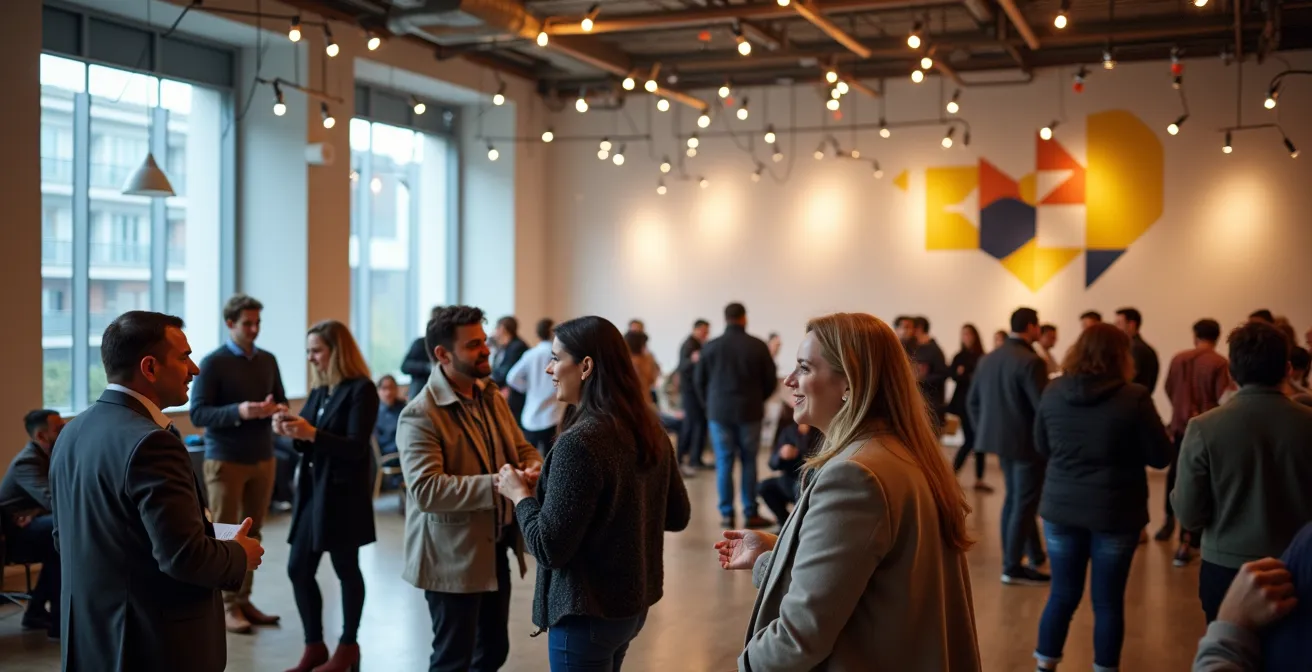
The key to successful local events isn’t brand visibility; it’s strategic activation that turns every interaction into a qualified lead.
- Passive tactics like logo sponsorships and swag giveaways attract low-quality attention and drain your budget without measurable ROI.
- Active engagement—through interactive booths, structured networking, and experience-based fundraisers—filters for genuine interest and captures valuable customer data.
Recommendation: Stop paying for presence and start investing in participation. Shift your focus from “how many people see our logo?” to “how many meaningful conversations did we start?”
As a fitness franchise owner, you’ve likely played by the local marketing rulebook. You’ve hosted open houses, sponsored the local youth soccer team, and dutifully set up a booth at the community fair, hoping to turn handshakes into memberships. Yet, you’re often left with a pile of empty food trays, a list of unqualified emails from a prize drawing, and a sinking feeling that you’ve just funded a party for freebie seekers. The traditional advice focuses on getting your name “out there,” assuming that visibility will magically translate into sales. You put your logo on shirts, hand out branded pens, and hope for the best.
But what if this entire approach is fundamentally flawed? What if the goal isn’t just to be seen, but to be experienced? The problem isn’t the events themselves; it’s the passive mindset we bring to them. We treat them as an advertising expense rather than an active, lead-generating opportunity. The true power of grassroots marketing lies not in blanketing the town with your logo, but in creating moments of genuine connection and value exchange that attract your ideal clients and repel those just looking for a free water bottle.
This guide breaks that passive cycle. We will shift the focus from “sponsoring” to “activating.” Instead of just showing up, you’ll learn to design every event element—from your booth strategy to your staff’s talking points—with one clear goal: to build real relationships and generate qualified leads. It’s time to stop hosting expensive open houses and start building a powerful, community-driven sales funnel.
This article will guide you through the essential strategies to transform your community marketing efforts. You will discover how to measure ROI effectively, capture meaningful data, and build lasting brand loyalty that goes far beyond simple name recognition.
Summary: From Passive Presence to Profitable Partnerships
- The Jersey Fallacy: Why Putting Your Logo on Little League Shirts Doesn’t Drive Sales?
- Booth Strategy: How to Capture Data at Community Fairs Instead of Just Handing Out Pens?
- Networking ROI: How to Monetize Your Chamber of Commerce Membership?
- The “Dine and Donate” Model: Structuring Fundraisers That Actually Fill Your Restaurant
- The Brand Face: Training Your Staff to Be Ambassadors, Not Wallflowers, at Events
- Sponsorship vs Partnership: Why Writing a Check Doesn’t Build Brand Love Like Volunteering Does?
- The Soft Opening Mistake: Why You Need a Bang to Disrupt Local Habits?
- How to Transform Name Recognition into Deep Brand Loyalty in Your Community
The Jersey Fallacy: Why Putting Your Logo on Little League Shirts Doesn’t Drive Sales?
The quintessential local marketing tactic: sponsoring a kids’ sports team. Your logo gets printed on a few dozen jerseys, you get a “thank you” plaque, and you feel like a community hero. But when you look at your membership numbers, nothing has changed. This is the Jersey Fallacy—the mistaken belief that passive visibility equals effective marketing. Simply seeing your logo doesn’t compel a parent to sign up for your gym. They might appreciate the gesture, but it doesn’t create a connection or demonstrate the value you offer.
The problem is the lack of “activation.” Activation is the work you do to bring a sponsorship to life and engage the audience directly. It’s the difference between being a name on a shirt and being an active part of the community’s experience. Industry marketing research highlights this gap, showing the necessity of investing nearly 50% of the sponsorship fee in activation just to see a return. Without it, you’re only doing half the job.
Instead of just writing a check, think about how you can activate the sponsorship. Instead of just a logo, could you host a “Meet the Team” day at your fitness studio? Could you offer a free “Agility for Young Athletes” clinic for the players? Use the sponsorship as a content engine: create social media posts highlighting a “Player of the Week,” sharing game-day photos, and telling the story of your involvement. This transforms your investment from a passive donation into an active, relationship-building platform that showcases your expertise and facility.
Booth Strategy: How to Capture Data at Community Fairs Instead of Just Handing Out Pens?
The scene is familiar: a six-foot table, a branded tablecloth, a bowl for business cards, and a pile of cheap pens. Most businesses at a community fair are essentially waiting for people to approach them. This passive approach is a recipe for failure, attracting passersby interested only in the free giveaway. To generate real leads, you must transform your booth from a static display into an interactive “reciprocity engine.” Your goal is not to hand out swag, but to offer a valuable experience in exchange for a prospect’s time, attention, and data.
The data is clear: interactive booths generate up to 40% more leads than static ones. Ditch the fishbowl for a prize. Instead, create an engaging activity. For a fitness studio, this could be a “Grip Strength Challenge” with a leaderboard, a 30-second “Plank Contest,” or a quick functional movement screening performed by a trainer. These activities do three things: they draw a crowd, they allow your team to start natural conversations, and they create a reason to collect contact information that feels earned, not begged for.
This paragraph introduces the concept of an interactive booth. For a better understanding of how this engagement translates into leads, the visual below highlights key strategies.

As the image suggests, the focus is on genuine human interaction facilitated by an engaging setup. Once you have their attention, the data capture must be just as strategic. Use a tablet with a simple form asking targeted questions: “What’s your #1 fitness goal?” or “What’s preventing you from joining a gym?” This adds a layer of intentional friction that filters out the freebie seekers and gives you valuable qualifying information for your follow-up.
Case Study: Real-time Lead Qualification in Action
Modern event strategies go beyond simple data collection. Companies are now using in-booth technology to track attendee behavior in real-time. By monitoring which demos a person interacts with or how long they spend at a particular station, businesses can score leads based on actual interest. This behavioral data, synced instantly with a CRM, allows sales teams to prioritize follow-ups with highly engaged prospects, leading to response rates up to 60% higher than those from generic badge scans. This method ensures that the first call you make is to the person who showed the most genuine interest, not just someone who wanted a free pen.
Networking ROI: How to Monetize Your Chamber of Commerce Membership?
Joining the local Chamber of Commerce is a standard move for any small business, but many owners find themselves attending mixers, collecting dozens of business cards, and seeing zero return on their membership dues. The error is treating networking as a game of quantity—meeting as many people as possible. Effective networking is about quality and strategy, not volume. The goal isn’t to talk to everyone, but to build deep, reciprocal relationships with a select few.
The most effective strategy is to ditch the “meet everyone” approach and build a “Referral Pod.” This is a small, dedicated group of 4-5 professionals in non-competing industries who share a similar target client. For a fitness franchise owner, this pod might include a physical therapist, a nutritionist, a corporate wellness consultant, and a high-end realtor. You focus 80% of your networking energy on this pod, meeting regularly to learn each other’s businesses inside and out so you can generate high-quality, pre-qualified referrals for one another. You stop pitching “what I do” and start explaining “who I’m looking for,” making it easy for your pod to send the right people your way.
This table breaks down why a strategic approach to networking outperforms traditional methods. As shown in a recent comparative analysis, focusing on high-quality connections delivers far greater results.
| Strategy Type | Lead Quality | Conversion Potential | Best Practice |
|---|---|---|---|
| Referral Pod (4-5 non-competing businesses) | High | Very High | Focus 80% of networking energy on pod members |
| Traditional Networking (meet everyone) | Mixed | Low-Medium | Surface-level connections with many |
| ‘Who I’m Looking For’ Pitch | High | High | Describe ideal referral in concrete terms |
| ‘What I Do’ Pitch | Low | Low | Generic elevator pitch approach |
Finally, your follow-up must be as strategic as your networking. Instead of a generic “Nice to meet you” email, reference your conversation and offer immediate value. Send a link to an article you discussed, introduce them to someone in your network, or share a relevant insight. This data-driven, personalized approach is proven to work; post-event analysis shows that it can lead to a 20% increase in attendee satisfaction and solidifies the relationship far more effectively than a generic template.
The “Dine and Donate” Model: Structuring Fundraisers That Actually Fill Your Restaurant
For businesses like restaurants or fitness studios with physical space, the “Dine and Donate” night is a common way to support local charities. You agree to donate a percentage of sales from a specific evening to a non-profit. While well-intentioned, this model is often a financial disappointment. You have little control over turnout, and the non-profit partner has little incentive to market the event aggressively. You risk an empty establishment and a minuscule donation that builds goodwill with neither the charity nor potential customers.
The solution is to flip the model from passive percentage-giving to an active, experience-based partnership. Instead of hoping people show up, you create exclusive, ticketed events that guarantee upfront revenue and attract a more engaged, higher-value clientele. This approach shifts the dynamic to one of shared responsibility. For example, you can structure a tiered partnership. A low-engagement tier might be the classic “Dine & Donate,” but higher tiers offer much more value for both parties.
A “Guest Bartender” night, where local celebrities or community leaders work for tips that go to the charity, creates a draw and a fun atmosphere. The highest tier is a fully ticketed experience—a private cooking class with your chef, a special wine-pairing dinner, or a “behind-the-scenes” tasting event. For a fitness studio, this could be a “Yoga for a Cause” workshop or a charity boot camp. These events are not free; attendees purchase tickets, guaranteeing your revenue while providing a unique experience. Crucially, your agreement should include a “Shared Responsibility” clause, requiring the non-profit partner to sell a minimum number of tickets, ensuring they are just as invested in the event’s success as you are.
The Brand Face: Training Your Staff to Be Ambassadors, Not Wallflowers, at Events
You can have the most interactive booth and the best event strategy, but it all falls apart if your staff stands behind the table staring at their phones. At any local event, your team members are not just employees; they are the living embodiment of your brand. Their energy, confidence, and ability to connect are your most powerful marketing tools. Yet, most businesses fail to train their staff for this crucial role, leaving them to feel awkward and unprepared.
Your job is to transform them from passive “wallflowers” into proactive “ambassadors.” This requires specific training and clear goals that go beyond “get leads.” Start with a pre-event huddle where you set non-sales goals, like “have 30 meaningful conversations” instead of “get 30 sign-ups.” Equip them with three core narratives: a powerful customer success story, their personal “why I love working here” story, and the company’s authentic origin story. These stories are far more memorable than a list of membership prices.
This image symbolizes the goal: to facilitate a genuine exchange of value and connection, not just a one-way sales pitch. Your staff are the ones making this exchange happen.

To make engagement fun and measurable, gamify it. Create “Event Bingo” cards with tasks like “Learn a community leader’s name,” “Introduce two people to each other,” or “Capture a video testimonial.” This gives your team a clear, fun mission. Afterwards, hold a post-event debrief to gather intelligence. Ask them: “What were the most common questions?” “What surprised you?” “What are the community’s real needs?” This turns your team into a vital source of market research and ensures they feel valued for their role in the event’s success.
Your Action Plan: Turning Staff into Event Superstars
- Equip with Stories: Train every staff member on three key narratives: a powerful customer success story, their personal “why,” and the company’s origin story.
- Gamify Engagement: Create “Event Bingo” cards with specific, non-sales tasks like ‘Introduce two new people’ or ‘Ask someone about their biggest fitness challenge’ to encourage proactive conversation.
- Set Connection Goals: In a pre-event huddle, set clear goals focused on quality interactions (e.g., “20 meaningful conversations”) rather than just lead quantity.
- Conduct Intelligence Debriefs: Hold a post-event meeting to gather insights. Ask what questions were most frequent and what community needs they uncovered.
- Empower with Openers: Provide them with easy, open-ended conversation starters that go beyond “Can I help you?” such as “What brings you to the fair today?” or “Have you tried the grip strength challenge yet?”
Sponsorship vs Partnership: Why Writing a Check Doesn’t Build Brand Love Like Volunteering Does?
As we’ve explored, the line between effective and ineffective local marketing often comes down to one key distinction: the difference between a sponsorship and a true partnership. A sponsorship is a transaction; you write a check in exchange for logo placement. It’s a passive, one-way relationship focused on visibility. A partnership is a collaboration; it involves a shared investment of time, effort, and resources toward a common goal. It’s an active, two-way relationship focused on impact and connection.
Brand love isn’t built by seeing a logo on a banner. It’s built by seeing a business and its employees actively participating in and improving the community. Volunteering is the ultimate form of partnership activation. When your fitness studio’s team volunteers to run the water station at a local 5K, helps build a new playground, or hosts a free health workshop at the senior center, you are demonstrating your values, not just advertising them. This creates a much deeper emotional connection than any financial contribution ever could.
Before committing to any community involvement, apply the Partnership Litmus Test. First, test for shared goals: do both you and the organization want to achieve the same outcome beyond a simple financial exchange? Second, test for shared effort: will both sides be actively involved, or are you the only one contributing resources? Finally, test for shared metrics: can you define success in a way that benefits both organizations? A great partnership model is co-creation, where you work with another group to create something new from scratch—like a tech company and a library launching a “Kids Coding Club.” This ensures deep integration and shared ownership, moving far beyond a simple sponsorship transaction.
The Soft Opening Mistake: Why You Need a Bang to Disrupt Local Habits?
For a new business, the “soft opening” feels like a safe, low-pressure way to launch. You quietly open your doors, hoping word-of-mouth will slowly build. But in a crowded local market, a quiet launch is often a silent failure. Local consumers are creatures of habit. They already have their gym, their coffee shop, their routines. A soft opening is not disruptive enough to break those habits. To succeed, you don’t need a whisper; you need a strategic and resounding “bang” that makes the community take notice.
Instead of a single, generic “Grand Opening,” implement a “Staggered Launch Sequence.” This involves a series of smaller, exclusive preview events, each targeting a specific micro-community. Host a private workout session for local fitness bloggers and influencers. Hold an exclusive “neighbor-to-neighbor” night for owners of adjacent businesses. Organize a special reception for the board members of the Chamber of Commerce. This strategy builds phased momentum, generates authentic social proof from trusted community figures, and allows you to tailor your message to each group.
The most powerful launch strategy frames your business as the solution to a community void. Don’t just open a gym; launch the town’s first “Weekly Seniors’ Mobility & Balance Club.” Don’t just be another studio; position your opening as the “First Annual Community Health & Wellness Fair.” By anchoring your launch to a recurring event or a problem-solving initiative, you immediately embed your brand into the fabric of the community. You move from being a new, unknown entity to a valued local tradition from day one, giving people a compelling reason to break their old habits and form a new one with you.
Key Takeaways
- Stop passive sponsorship and start active engagement. Your ROI depends on the experiences you create, not just your logo’s visibility.
- Design every event touchpoint—from your booth to your staff—to filter for high-quality leads and capture valuable data, not just to attract crowds.
- Transform one-off events into a long-term loyalty program by creating “Community Containers” that keep the conversation going long after the event ends.
How to Transform Name Recognition into Deep Brand Loyalty in Your Community
You’ve run the activated sponsorships, hosted the interactive booth, and launched with a bang. People in town now know your name. But name recognition is not the end goal; it’s the starting line. The final, most crucial step is to convert that fleeting awareness into deep, lasting brand loyalty. This is where many businesses drop the ball. They treat an event as a one-time transaction, failing to nurture the connections they’ve made. While industry benchmarks indicate lead conversion rates from events average between 10% and 30%, true loyalty is built in the follow-through.
The key is to combat the “Post-Event Letdown” by creating permanent “Community Containers.” An event is a temporary gathering, but a container is a permanent home for the community you’ve started to build. This isn’t just a mailing list; it’s a platform for ongoing engagement. This could be a private Facebook Group for attendees of your wellness workshops, a dedicated “Community Corner” in your newsletter that features member stories, or a recurring in-person meetup like a monthly running club that starts and ends at your studio.
These containers serve a vital purpose: they keep the value flowing long after the initial event. You can share exclusive content, offer early access to new classes, ask for feedback, and facilitate connections between members. This transforms your role from a service provider into a community leader. You are no longer just the place people go to work out; you are the hub that connects like-minded individuals. By consistently providing value and fostering a sense of belonging within these containers, you turn a list of leads into a loyal tribe of brand advocates who will not only stay with you but will become your most powerful marketing asset.
By shifting your mindset from passive visibility to active engagement, you transform your local events from a frustrating expense into your most powerful engine for growth. Start implementing these strategies today to build a loyal community and a thriving business.