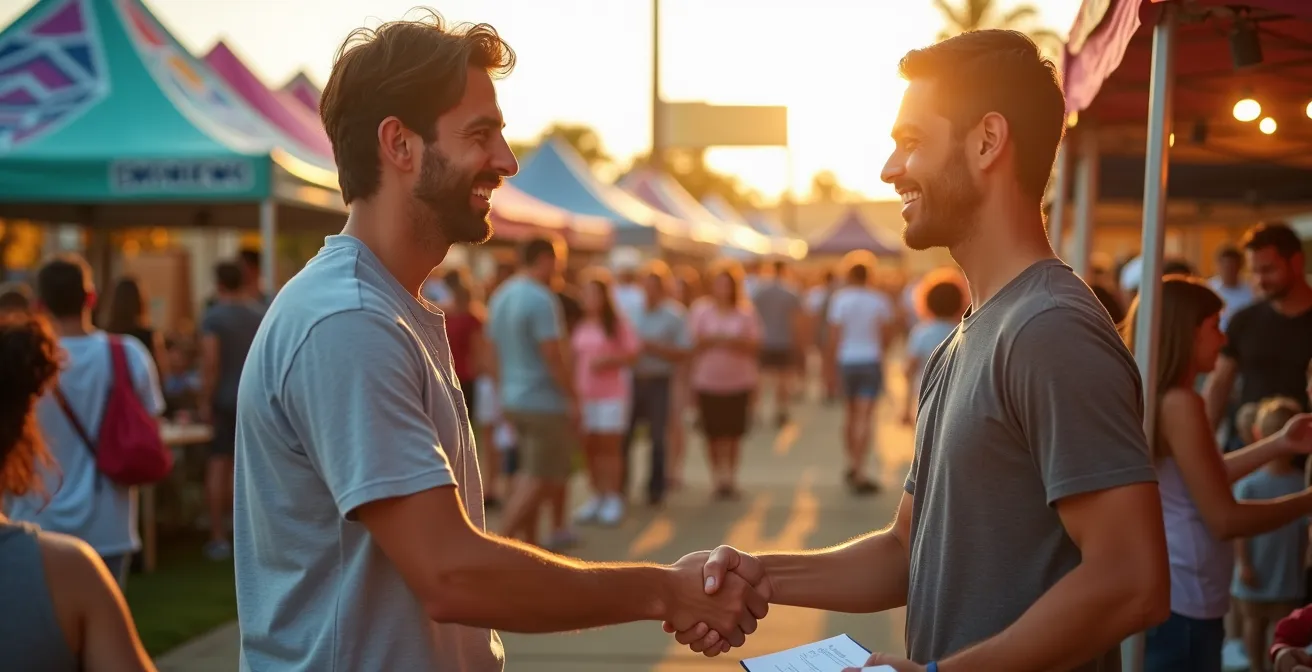
Sponsoring local events generates real ROI only when you treat them as strategic sales funnels, not just a branding expense.
- Build authentic trust through face-to-face interactions, which are proven to be the most effective marketing channel.
- Ditch outdated methods like fishbowls; use digital tools to capture lead data seamlessly.
- Implement a disciplined, context-based follow-up system to convert event leads into actual sales.
Recommendation: Shift your mindset from passive visibility to active lead conversion at every event you sponsor. Your goal isn’t just to be seen; it’s to start a profitable conversation.
As a franchisee, you’ve probably been there. You write a check to sponsor the local school fair or community festival, hang a banner with your logo, and hope for the best. You see it as a necessary cost of doing business, a way to “get your name out there.” But when you look at your sales figures the following week, you see no discernible bump. The sponsorship feels less like an investment and more like a donation with no clear return. The common advice is to hand out flyers or run a giveaway, but these efforts rarely translate into loyal, paying customers.
This approach is fundamentally flawed because it treats event marketing as a passive branding exercise. It completely misses the immense potential of a captive, local audience that is physically in front of you. But what if the true key to unlocking event ROI wasn’t about having the biggest banner, but about having the smartest strategy? What if you stopped thinking about “sponsorship” and started thinking about building an offline sales funnel?
This guide is built on that single, powerful shift in perspective. We’re going to move beyond feel-good visibility and give you a pragmatic framework to turn every handshake into a lead and every lead into a customer. We’ll break down the entire process, from choosing the right event and engaging attendees effectively to converting those new contacts into measurable business by the time you’re back in the office on Monday morning. It’s time to make your local event budget your most powerful customer acquisition tool.
This article provides a complete roadmap for transforming your local sponsorships into high-ROI marketing machines. Below is a summary of the key strategies we’ll cover, from building initial trust to retaining your most valuable clients.
Summary: A Franchisee’s Guide to High-ROI Event Marketing
- Why Handshaking at a Fair Beats an Email Blast for Building Trust?
- Little League or Charity Gala: Which Sponsorship Fits Your Target Persona?
- Fishbowl or Wheel Spin: How to Capture Data at Your Event Booth?
- The “Empty Table” Error: Why Sitting Behind Your Booth Wastes Your Time?
- How to Turn a Stack of Business Cards into Sales by Tuesday Morning?
- How to Partner with Schools and Charities to Build Deep Trust?
- How to Create a “Must-Visit” Frenzy During Your First Weekend?
- Customer Retention: How to Get Your Best Clients to Visit One More Time per Month?
Why Handshaking at a Fair Beats an Email Blast for Building Trust?
In a world saturated with digital noise, a genuine, face-to-face interaction is more powerful than ever. An email can be deleted with a click, but a real conversation builds a foundation of trust that digital channels struggle to replicate. This isn’t just a feeling; it’s a proven business driver. The first stage of your offline funnel is leveraging this human connection. When you meet someone in person, you engage more than just their eyes; you trigger a deeper, more memorable experience.
The data on this is incredibly clear. According to GTM Partners, 80% of respondents consider in-person events the most trusted marketing channel. This trust translates directly into business results, with companies reporting a tenfold return on investment from event attendees compared to non-attendees. The simple act of a handshake and a conversation creates an emotional connection. This is because face-to-face interactions can trigger the release of oxytocin, often called the “trust hormone,” fostering a genuine rapport that an email signature simply cannot.
Furthermore, this trust is especially vital for building relationships with younger consumers. Research shows that 71% of younger generations report increased trust in a brand after interacting with it at a live event. This is your opportunity to move from being a faceless logo to a friendly, trusted member of the community. Every conversation is a chance to understand a potential customer’s specific needs and demonstrate that you’re there to help, not just to sell. This is the bedrock on which all future sales are built.
Ultimately, a successful event presence isn’t measured by how many flyers you distribute, but by how many meaningful conversations you start. It’s the first and most critical step in turning a local resident into a loyal customer.
Little League or Charity Gala: Which Sponsorship Fits Your Target Persona?
Now that you understand the power of in-person connection, the next crucial decision is where to invest your time and money. Not all local events are created equal, and choosing the wrong one is like fishing in a pond with no fish. The key is to move away from random acts of sponsorship and toward a strategic selection based on one simple question: “Where does my ideal customer spend their free time?” Answering this question is the difference between shouting into the void and having a focused conversation with your future best clients.
The choice between sponsoring the local Little League team or a high-end charity gala depends entirely on your target persona. If you’re a family-friendly restaurant, the baseball field is your prime territory. If you offer high-value B2B services, the gala is where you’ll meet decision-makers. The goal is to align the event’s audience with your own, ensuring that every person you meet is a potential customer.
To help you make a data-driven decision, here is a breakdown of common event types and the strategic advantages they offer. This framework helps you analyze potential sponsorships not by their cost, but by their potential for reaching your specific customer segment.
| Event Type | Primary Audience | Second-Order Reach | Best For | Typical Cost Range |
|---|---|---|---|---|
| Little League/Youth Sports | Families with children | Community Facebook groups, local social media | Top-of-funnel awareness, lead volume | $500-$5,000 |
| Charity Gala | Wealthy donors, business leaders | Local media coverage, influential networks | Bottom-of-funnel relationship building | $5,000-$25,000 |
| Community Festival | General local population | Wide social media sharing | Brand visibility, product demos | $1,000-$10,000 |
| Industry Conference | Decision-makers, professionals | Industry publications, LinkedIn | High-value lead generation | $10,000-$50,000 |
By strategically selecting your event, you’re not just buying visibility; you’re buying access to a pre-qualified audience. This single decision dramatically increases the efficiency and ROI of your entire event marketing effort.
Fishbowl or Wheel Spin: How to Capture Data at Your Event Booth?
You’ve chosen the right event and you’re having great conversations. The next stage in your offline funnel is capturing contact information so you can continue that conversation after the event. For decades, the go-to methods have been the business card fishbowl or the prize wheel with a paper sign-up sheet. While familiar, these methods are inefficient, create manual work, and often result in a pile of illegible email addresses. It’s time to modernize your approach to data capture to match your modern business.
The goal is to lower the “activation energy” required for someone to give you their information. The easier you make it, the more leads you’ll get. Instead of asking someone to stop, find a pen, and write on a clipboard, you can use technology to make the exchange seamless and instant. This shift from analog to digital is critical for maximizing your lead capture and ensuring the data is accurate and immediately usable.
Modern booths leverage digital tools to create a value-first exchange. This means offering something of immediate, guaranteed value—like a helpful digital guide or a discount code sent directly to their phone—in exchange for their contact information. This is far more effective than a lottery-style giveaway where most people leave with nothing.
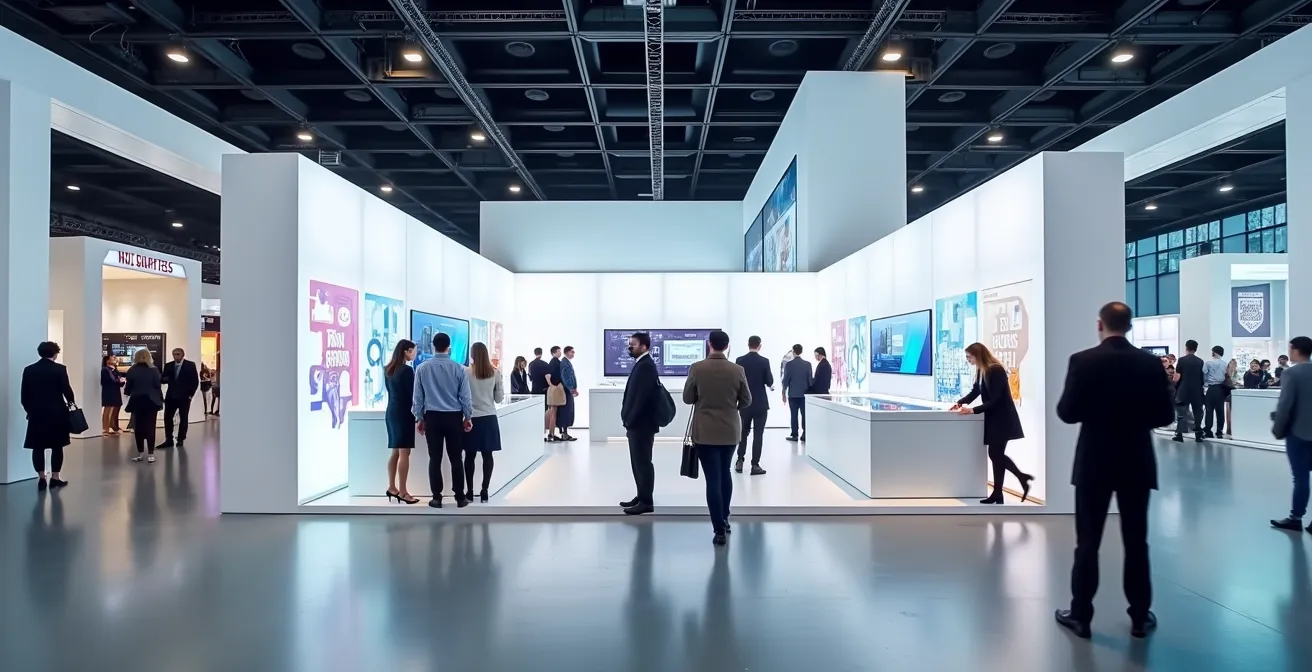
As you can see, a modern booth is an interactive space. Here are some effective strategies to implement:
- Use QR Codes: A simple QR code can link to a digital sign-up form. Attendees can scan it with their own phone, making the process quick and private. You can even use different QR codes to segment leads based on where they scanned it.
- Equip Staff with Digital Business Card Apps: After a great conversation, your team can seamlessly exchange contact info using an app, which automatically syncs the new contact to your CRM.
- Offer Utility: A phone charging station that requires an email registration is a brilliant way to provide a genuinely useful service while capturing a lead. It’s a magnet for attendees with low batteries.
This tech-forward approach respects the attendee’s time, improves data quality, and positions your brand as professional and efficient right from the first interaction.
The ‘Empty Table’ Error: Why Sitting Behind Your Booth Wastes Your Time?
One of the most common and costly mistakes at any local event is what I call the “Empty Table Error.” It’s the sight of a company representative sitting behind a folding table, scrolling on their phone, waiting for people to approach them. This passive stance turns your expensive sponsorship into a glorified billboard. You aren’t there to be a static display; you are there to actively engage, build relationships, and guide people into your offline funnel. Your physical presence is your greatest asset, and hiding behind a table neutralizes it completely.
To maximize your ROI, your team needs to be in front of the table, not behind it. They should be standing, smiling, making eye contact, and initiating conversations. This proactive approach transforms the dynamic from a passive browse to an active engagement. The goal is to create a welcoming and approachable presence that invites people in. Remember, research from Freeman shows that 65% of customers say product demos and live events helped them understand a product better than any other method. You can’t give a great demo from a chair.
This active engagement directly builds the trust we discussed earlier. The same study found that when staff actively engage, 77% of attendees report increased trust in the brand. This is your chance to measure your team’s effectiveness with a simple metric: the Interaction-to-Lead Ratio (ILR). How many conversations are your staff starting, and how many of those are turning into qualified leads? This focus on proactive connection is supported by senior executives, as highlighted in a key study.
62% chose event marketing as the discipline that best accelerates and deepens relationships
– EventView Study, 2009 EventView study of senior executives in sales and marketing
This acceleration only happens when you are actively building those relationships, not passively waiting for them.
Train your team to be conversation starters, not booth guardians. Their mission is to create a positive, memorable human interaction that leaves a lasting impression and fills your sales funnel.
How to Turn a Stack of Business Cards into Sales by Tuesday Morning?
The event is over, you’re back in your office, and you have a stack of business cards or a newly populated spreadsheet. This is the moment where most event marketing ROI dies. Without a disciplined and immediate follow-up system, that stack of potential leads will quickly go cold. A 2017 Eventbrite survey found that 40% of sponsorship professionals say measuring ROI is a top challenge. The reason is often a failure to bridge the gap between the event and the sale. The “Conversion” stage of your funnel requires speed, context, and value.
The key is to act within 24 hours while the memory of your conversation is still fresh. But a generic “Nice to meet you at the event” email is not enough. Your follow-up must be personal and valuable. This is where the “Context is King” approach comes in. During the event, train your staff to jot down a unique keyword on the back of each business card (or in the notes field of your digital app) that relates to your conversation. “Loves golden retrievers,” “planning kitchen reno,” or “asked about gluten-free” are all powerful hooks for a personalized follow-up.
This contextual information allows you to execute a multi-channel warm-up sequence that feels personal, not automated. Your first message should always provide value before you ask for a sale. Did you promise to send an article, an introduction, or a resource? Do that first. This builds on the trust you established at the event and proves you’re a valuable contact. Here is a practical plan to turn those leads into legitimate sales opportunities.
Your Action Plan: Post-Event Lead Conversion
- Immediate Sorting & Contextual Notes: At the end of the event, immediately review each lead and ensure your contextual keyword (“planning kitchen reno”) is clearly noted in your CRM or spreadsheet.
- The 24-Hour Value-Add Rule: Within one business day, send your first follow-up. It must lead with value—the article you promised, a link to a relevant case study, or a helpful tip related to your conversation. Do not pitch.
- Multi-Channel Warm-Up: Initiate a sequence. Day 1: Send a LinkedIn connection request with a short message referencing the event. Day 2: Send your value-add email. Day 3 or 4: Make a follow-up call or send a second email to transition into a sales conversation.
- Automate Logistics, Personalize Content: Use tools like business card scanner apps to automate the data entry into your CRM, but always manually craft the follow-up messages using your contextual notes.
- Track Engagement Metrics: Monitor the open rates and click-through rates of your follow-up emails. High engagement is a strong indicator of brand recall and interest, signaling which leads are hottest.
By treating the follow-up with this level of strategic importance, you close the loop on your offline funnel and turn event attendance into a predictable and profitable source of new business.
How to Partner with Schools and Charities to Build Deep Trust?
Sponsoring a one-off event is good, but embedding your business into the fabric of the community is great. The highest level of local marketing is moving from being a “sponsor” to being a “partner.” This is especially powerful when working with trusted local institutions like schools and charities. These partnerships allow you to build a deep, sustained level of trust that a single event can’t achieve. It demonstrates a long-term commitment to the community’s well-being, which resonates powerfully with local customers.
The impact of this strategy is significant. According to event marketing data, 74% of attendees say their opinion of a company improved after attending an event hosted or supported by them. When that event is for a beloved local cause, the positive association is even stronger. This is about showing your community that you care about the same things they do. It’s a strategy focused on creating shared value, where your business’s success is linked to the success of the community.
The most effective partnerships go beyond just writing a check. The key is to offer your core competency, not just your cash. If you’re a marketing agency, offer to run a pro-bono campaign for the charity’s annual fundraiser. If you’re a restaurant, host a series of healthy cooking classes for students at a local school. This approach creates authentic, impact-focused stories that are far more powerful than a logo on a banner. It’s about co-creating programs that deliver real community benefits, with your brand positioned as the enabler.
Here are some ways to build these deep partnerships:
- Develop New Initiatives: Instead of just sponsoring the annual fun run, partner with a school to create a new “Financial Literacy for Teens” program, positioning your financial planning firm as a community educator.
- Enable Employee Volunteerism: Include paid volunteer hours as part of your partnership deal. Having your team physically present and helping out shows a level of personal investment that money can’t buy.
- Focus on Long-Term Relationships: Commit to a multi-year partnership that can evolve. This shows you’re invested in sustainable impact, not just a quick marketing win.
By becoming an active and indispensable partner, you achieve “community embedding.” You’re no longer just a business in the neighborhood; you’re a part of the neighborhood. This is the ultimate form of customer loyalty.
How to Create a ‘Must-Visit’ Frenzy During Your First Weekend?
Whether it’s your grand opening or a major seasonal promotion, you need to generate immediate buzz. Creating a “must-visit” frenzy is about transforming your event from a passive open house into an active, shareable experience. In today’s social media-driven world, your attendees are your most powerful marketers. The key is to give them something worth talking about and sharing. You need to engineer moments that are visually appealing and inherently shareable.
The data on this is compelling: research shows that a staggering 98% of consumers create digital or social content at events. Your job is to make it easy and desirable for them to do so in a way that promotes your brand. Successfully engineered “Instagrammable moments” can create organic reach that extends far beyond the people who physically attend. When people see their friends and neighbors having a great time at your location, it creates powerful social proof and a fear of missing out (FOMO) that drives more traffic.
So, how do you create these moments? It’s about being creative and thinking from the perspective of a social media user. What would make someone pull out their phone and take a picture or video? Here are a few practical ideas for a franchisee:
- A Themed Photo Booth: Go beyond a simple backdrop. If you’re a pet store, create a “pet throne” where owners can take regal photos of their dogs. If you’re a fitness studio, have a backdrop with a playful “I survived my first workout” message and fun props.
- Interactive Challenges: Gamify the experience. A coffee shop could have a “latte art pour-off” challenge. A hardware store could host a “fastest to assemble a flat-pack chair” contest. The energy and fun are naturally shareable.
- Unique Visuals: Think about what looks cool on camera. This could be an unusually colorful food item, a spectacular product demonstration (think “will it blend?”), or even just a beautifully designed corner of your store with perfect lighting.
By tapping into the power of user-generated content, you turn your first weekend into a self-perpetuating marketing engine, creating a wave of excitement and awareness that money alone can’t buy.
Key Takeaways
- Treat every local event as a strategic, multi-stage “offline sales funnel” to ensure measurable ROI.
- Active, face-to-face engagement is crucial; train staff to get out from behind the table to build trust and initiate conversations.
- Modernize your data capture with digital tools like QR codes and focus on a disciplined, context-rich follow-up system to convert leads into sales.
Customer Retention: How to Get Your Best Clients to Visit One More Time per Month?
Your offline funnel doesn’t end when you make a sale. The final, and perhaps most profitable, stage is retention and advocacy. Local events are a phenomenal tool for strengthening relationships with your existing best customers. Making your top clients feel like VIPs not only encourages them to visit more often but also transforms them into powerful brand ambassadors within the community. It’s often easier and more cost-effective to get an existing customer to come back than it is to acquire a new one.
The strategy is to leverage your event sponsorships to create exclusive experiences for your top-tier clients. This is about “surprise and delight.” When your best customers feel recognized and valued, their loyalty deepens. For example, if you’re sponsoring a local concert series, reserve a few of the best seats for a surprise giveaway to your top 20 clients. This small gesture creates a memorable experience they will associate with your brand and talk about with their friends.
This focus on existing customers is a powerful driver of long-term growth. You can host small, exclusive “insider” micro-events that aren’t about selling at all. A restaurant could host a private “Chef’s Table” tasting. A financial advisor could host an “Economic Outlook Dinner” for top clients. These non-sales events provide immense value and cement your role as an expert and a trusted partner. Another powerful strategy is to establish a Customer Advisory Board that meets quarterly at a local venue, giving your best clients a voice and making them feel invested in your success.
This entire process circles back to the core challenge of demonstrating a return on your investment. As research from Forrester confirms, 95% of events teams say demonstrating event ROI is their top priority. By using events to increase the visit frequency and lifetime value of your best customers, you create a direct and measurable line between your event spending and your bottom-line revenue.
By investing in your best customers through these targeted event strategies, you close the loop on your funnel, creating a cycle of loyalty and advocacy that fuels sustainable growth for your franchise.