
The secret to a sub-$25 Cost Per Lead isn’t spending more on ads; it’s surgically eliminating budget waste from your entire acquisition process.
- Focus on high-intent channels like the Google Map Pack, which convert better than broad awareness campaigns.
- Direct every ad to a dedicated, high-speed landing page, not your homepage, to double conversion potential.
Recommendation: Implement a “Speed to Lead” system to contact every new lead within 5 minutes—this single change can triple your close rate on the leads you’ve already paid for.
For any franchisee, the digital marketing landscape can feel like a casino where the house always wins. You pour money into Google and Facebook, hoping for a flood of new customers, only to be left with a high Cost Per Lead (CPL) and a questionable return on investment. The constant pressure to “be online” often leads to expensive campaigns that generate more clicks than customers, leaving you wondering if there’s a more sustainable path to growth. You’ve likely heard the standard advice: test your ads, know your audience, create better content. But these platitudes rarely address the core issue.
The problem isn’t a lack of effort; it’s a flawed strategy. Many businesses focus on “vanity metrics” like impressions and website traffic, which feel good but don’t pay the bills. They treat all leads as equal and follow a generic marketing funnel that ignores the crucial differences in customer intent. This approach is a recipe for budget leakage at every step, from the initial ad click to the final sales conversation. It’s time to stop gambling with your marketing budget and start engineering profitability.
But what if the key to a sub-$25 CPL wasn’t about finding a magic-bullet ad platform, but about adopting a ruthless, analytical mindset focused on one thing: eliminating waste? This guide provides a strategic framework to do just that. We will move beyond generic advice to give you a clear, ROI-driven system. We’ll show you how to redefine success, dominate high-intent local channels, and optimize every touchpoint to ensure every dollar you spend is an investment, not an expense. This isn’t about working harder; it’s about working smarter to build a predictable and profitable customer acquisition machine.
This article provides a step-by-step framework for franchisees to analyze and optimize their digital marketing spend. Below is a summary of the key strategies we will cover to help you systematically lower your CPL and accelerate profitability.
Summary: A Strategic Framework to Lower Your CPL
- Why You Should Ignore Vanity Metrics and Focus on Conversions?
- How to Rank in the “Google Map Pack” for Keywords Near You?
- Google Ads or Facebook Ads: Which Platform Delivers “Ready to Buy” Leads?
- The Conversion Killer: Why Sending Ads to Your Home Page Wastes 50% of Budget?
- How to Call Leads Within 5 Minutes to Triple Your Conversion Rate?
- How to Use Mobile Location Data to Validate a High-Rent Location?
- How to Accelerate Your Path to Profitability by 3 Months?
- Social Media: How to Post Content That Actually Drives Foot Traffic?
Why You Should Ignore Vanity Metrics and Focus on Conversions?
The first step in engineering a lower CPL is to radically redefine what success looks like. Clicks, impressions, and follower counts are “vanity metrics”—they look good on a report but have little correlation with revenue. The only number that truly matters is your Maximum Allowable CPL, the most you can afford to pay for a lead while still hitting your profit targets. Focusing on this metric forces a shift from a “get more clicks” mindset to a “generate more profit” strategy. Any ad spend that produces leads above this threshold is actively eroding your profitability.
Calculating this figure is not complex, but it is the foundational piece of a performance-driven marketing strategy. It transforms marketing from a cost center into a predictable driver of growth. Once you know your Maximum Allowable CPL, every decision—from which ad platform to use to how much to bid—becomes an objective, data-driven choice. The goal is no longer to simply be “below average,” which can range from $20 to over $200 depending on the industry, but to be profitable on every single conversion. This is the first and most critical act of eliminating waste.
This calculation provides the financial guardrails for your entire marketing operation. It allows you to confidently scale campaigns that are working and immediately cut those that are not, without emotional attachment. This analytical approach is what separates struggling franchisees from those who build a scalable, profitable customer acquisition engine. It all starts with knowing your numbers.
Your Action Plan: Calculate Your Maximum Allowable CPL
- Determine Customer Lifetime Value (CLV): Calculate your average purchase value, multiply it by the average purchase frequency per year, and then multiply by your average customer lifespan in years.
- Factor in Your Sales Closing Rate: Take your CLV and multiply it by your historical lead-to-customer conversion rate. For example, if you close 1 out of 5 leads, your rate is 20% (0.20).
- Apply Your Target Profit Margin: Decide on your desired profit margin (e.g., 30%). Multiply the result from the previous step by (1 – your profit margin). The final number is your Maximum Allowable CPL.
By establishing this financial baseline, you create a clear benchmark against which all future marketing efforts can be measured, ensuring every dollar is accountable.
How to Rank in the “Google Map Pack” for Keywords Near You?
For any franchisee with a physical location, the most valuable real estate on the internet is the Google “Map Pack.” This block of three businesses, displayed with a map for local searches like “plumber near me,” captures users with the highest purchase intent. These aren’t people doing research; they are people ready to buy, right now. Securing a spot here is the most direct way to capture high-quality, low-cost leads before your competitors even have a chance to show them an ad.
The power of the Map Pack lies in its ability to bypass the traditional ad auction. While it takes strategic effort, ranking here is primarily driven by relevance and trust, not ad budget. A fully optimized Google Business Profile (GBP) is your primary tool. This includes filling out every section, uploading high-quality photos, encouraging customer reviews, and consistently using the Q&A feature. Each positive review and answered question sends a powerful signal to Google that you are a legitimate, active, and trusted local business.
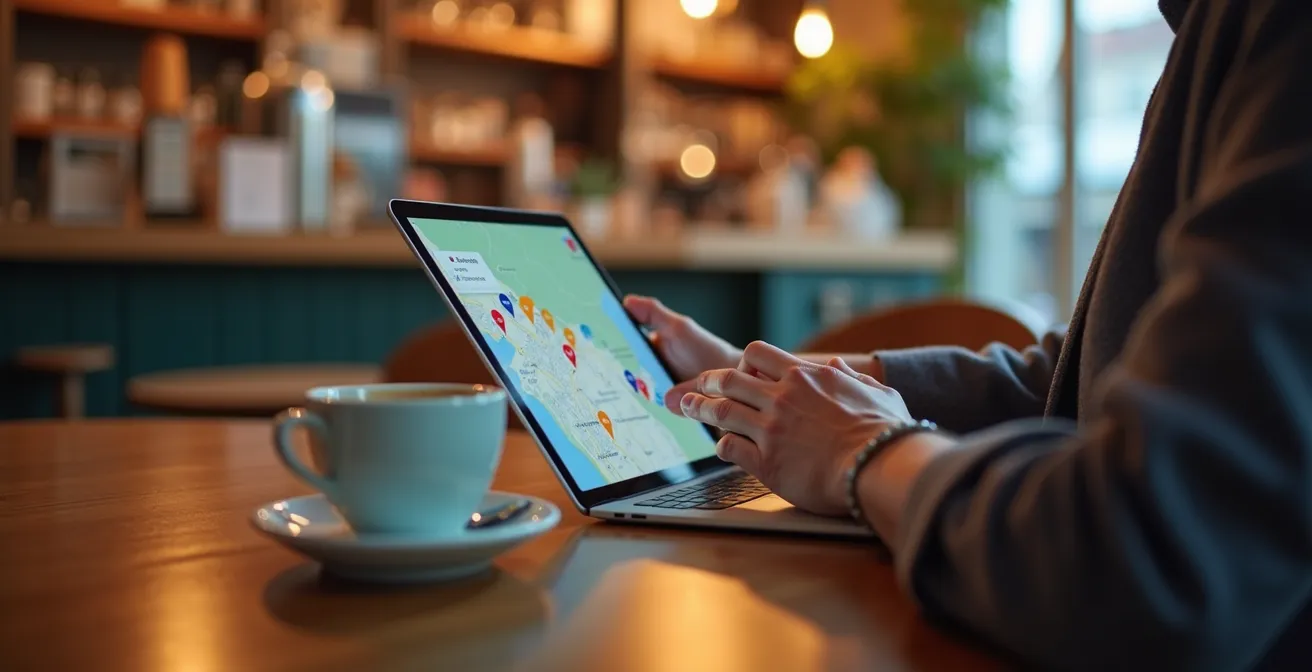
The results of this focus are not marginal. A 2024 study by SOCi revealed that businesses ranking in the top 3 Map Pack positions receive 126% more traffic and 93% more customer actions (like calls and direction requests) compared to those just a few spots lower. The study also found that comprehensive GBP optimization nearly doubles a business’s visibility in the 3-pack. This isn’t just about getting found; it’s about dominating the most profitable search results for your local market.
Prioritizing your GBP is a zero-budget strategy that directly targets “ready to buy” customers, representing the purest form of profitable lead generation.
Google Ads or Facebook Ads: Which Platform Delivers “Ready to Buy” Leads?
Once you’ve optimized for “free” local traffic, the next question is where to invest your paid budget. The “Google vs. Facebook” debate often misses the most critical factor: user intent. The two platforms serve fundamentally different stages of the customer journey, and using them correctly is key to avoiding wasted ad spend. Choosing the right platform isn’t about which one is “better,” but which one aligns with your immediate profitability goals.
Google Ads, particularly search ads, is an intent-harvesting platform. You are targeting “solution-aware” users who are actively searching for a product or service you offer. The intent to purchase is high, which often justifies a higher CPL because the lead quality is superior and the sales cycle is shorter. In contrast, Facebook Ads is an intent-generating platform. You are interrupting “problem-aware” users who are browsing their feed. They may have a need you can solve, but they aren’t actively looking for a solution. This makes Facebook excellent for building awareness and nurturing a long-term pipeline, but less effective for immediate, high-intent lead generation.
For a franchisee focused on accelerating profitability, the data points to a clear starting point. While Facebook may boast a high conversion rate for top-of-funnel actions, Google Ads delivers leads who are closer to making a purchase decision. The following table breaks down the typical performance, showing why a BOFU-first (Bottom-of-Funnel) strategy on Google is often the fastest path to ROI.
This comparative data, based on an analysis of platform performance, highlights the distinct roles each channel plays in a lead generation strategy.
| Platform | Average CPL | Best For | Typical Conversion Rate |
|---|---|---|---|
| Google Ads (PPC) | $100 | Solution-aware audiences | 3.75% |
| Facebook Ads | $50-75 | Problem-aware audiences | 9.21% |
| Content/SEO | $30 | Long-term pipeline | 5.0% |
Furthermore, savvy marketers look for “CPL arbitrage” opportunities on second-tier platforms like Quora or Reddit, where highly specific, intent-driven communities can be reached for a fraction of the cost of the major players. The principle remains the same: match your message to the user’s intent.
The Conversion Killer: Why Sending Ads to Your Home Page Wastes 50% of Budget?
One of the most common and costly mistakes in digital advertising is sending paid traffic to your website’s homepage. This single error can easily waste half of your ad budget. A homepage is designed for exploration; it’s a digital brochure with multiple messages, navigation options, and calls-to-action. It serves everyone but converts no one effectively. When a user clicks an ad with a specific promise, they expect a landing experience that directly fulfills that promise, without distraction. Sending them to a homepage creates a message mismatch, forcing them to work to find what they’re looking for, and most won’t bother.
The solution is a dedicated, purpose-built landing page. A landing page has one job and one job only: to convert the visitor from that specific ad campaign into a lead. This is achieved by maintaining perfect “scent” between the ad and the page—the headline, imagery, and offer should be an exact match. Critically, a high-converting landing page removes all distractions, most notably the main navigation menu. Studies have shown this simple change can increase conversions by up to 100%. You’ve paid for the click; the landing page’s job is to secure the conversion without giving the user an exit ramp.
The performance difference is stark. While a 2024 data analysis across thousands of pages shows a median conversion rate of 6.6%, optimized landing pages consistently outperform this benchmark. Success hinges on a few key elements: a lightning-fast load time (under 3 seconds), a single, clear call-to-action, compelling social proof (like reviews or testimonials), and a frictionless form. Every second of load time and every unnecessary form field is a potential leak in your budget, letting valuable, paid-for leads slip away.
By engineering a seamless, focused post-click experience, you stop wasting the traffic you’ve paid to acquire and start maximizing your return on ad spend.
How to Call Leads Within 5 Minutes to Triple Your Conversion Rate?
Generating a lead is only half the battle. The value of that lead decays exponentially with every minute that passes. The final—and often most neglected—stage of budget waste elimination is a slow lead response time. In the age of instant gratification, a lead that is not contacted immediately is a lead that is likely lost forever. The concept of “conversion velocity”—the speed at which you turn a lead into a conversation—is a massive competitive advantage.
The data on “Speed to Lead” is staggering and should be a wake-up call for every business. Research from InsideSales confirms that contacting a web lead within 5 minutes results in 8 times higher conversion rates compared to responding just 30 minutes later. After one hour, the odds of qualifying that same lead drop dramatically. When a potential customer fills out a form, their interest and intent are at their absolute peak. At that moment, they are actively thinking about their problem and your solution. Waiting allows that intent to cool, for distractions to set in, or—worst of all—for them to contact a competitor who responds faster.
Despite this clear evidence, a separate industry study found that only 7% of companies currently respond to leads within the critical five-minute window. This isn’t a failure of effort; it’s a failure of systems. Implementing an automated system is no longer a luxury but a necessity for profitability. This can be achieved using CRM automations that trigger instant notifications to your sales team, or specialized “speed to lead” software that can even initiate an automated call to both your team and the lead simultaneously. The investment in this technology pays for itself almost instantly by maximizing the value of the leads you’ve already paid dearly to acquire.
By optimizing for conversion velocity, you stop letting paid-for opportunities die on the vine and dramatically increase the ROI of your entire marketing spend.
How to Use Mobile Location Data to Validate a High-Rent Location?
For a franchisee, one of the largest fixed costs is rent. A prime location can drive significant foot traffic, but it comes at a premium. Before signing an expensive lease or investing heavily in ads for a new territory, you can eliminate significant financial risk by using anonymized mobile location data. This technology allows you to move from guesswork to data-driven validation, ensuring your target customers are actually present in a given area. This is a proactive form of waste elimination: confirming market viability *before* committing capital.
Instead of relying on outdated census data, you can analyze real-time foot traffic patterns around a potential location. This provides invaluable insights. For example, you can measure the daily, weekly, and seasonal visitor counts to a specific shopping center or commercial block. More importantly, you can analyze the demographic and psychographic profiles of these visitors to see if they match your ideal customer persona. Are they the right age? Do they have the right income level? Do their interests align with your brand?
This data empowers a highly targeted, pre-launch marketing strategy. By using these insights, you can build a powerful plan to reduce your initial CPL in a new market. Key strategies include:
- Analyze competitor foot traffic: Identify when your direct competitors are busiest and where their customers are coming from.
- Build lookalike audiences: Create digital ad audiences based on the device IDs of people who have visited complementary, non-competing businesses nearby.
- Set up strategic geo-fencing: Target users with specific offers when they enter a pre-defined geographic area, such as a trade show, a local event, or a competitor’s location.
- Validate customer personas: Use location data to confirm that the people you *think* are your customers are the ones actually frequenting the area, preventing costly assumptions.
By leveraging this intelligence, you can make smarter site selection decisions and design hyper-targeted ad campaigns that reach the right people in the right place, dramatically improving your chances of success from day one.
How to Accelerate Your Path to Profitability by 3 Months?
Reaching profitability quickly is paramount for any new franchisee. The traditional approach of building a slow, top-to-bottom marketing funnel can take six months or more to yield a positive ROI. A more aggressive strategy focused on profitability engineering can cut that time in half. This involves two core principles: ruthlessly applying the 80/20 rule to your existing campaigns and focusing your initial budget exclusively on the bottom of the funnel (BOFU).
First, conduct an 80/20 audit. It’s a near-universal law of marketing that 80% of your wasted spend comes from 20% of your campaigns or ad groups. Identify the ads that are driving up your CPL with minimal conversions and pause them immediately. This single action frees up capital to reinvest in your winners. This is especially critical considering that, on average, companies spend $92 on customer acquisition for every $1 spent on conversion optimization. Reallocating that misspent acquisition budget into optimizing your highest-performing assets is the fastest lever for improving ROI.
Second, adopt a “BOFU-First” focus. Instead of spending money on broad awareness campaigns, concentrate all of your initial budget on capturing high-intent users who are actively looking for a solution *now*. This means prioritizing Google Search ads targeting specific keywords and remarketing to recent website visitors. This strategy, combined with “offer splintering”—creating low-risk, entry-point offers to get a foot in the door—can dramatically lower initial CPL and shorten the time to first revenue. As the following table shows, this strategic focus has a profound impact on the timeline to profitability.
| Strategy | Time to Profitability | Initial CPL | Optimized CPL |
|---|---|---|---|
| BOFU-First Focus | 1-2 months | $50 | $25 |
| Offer Splintering | 2-3 months | $75 | $30 |
| Traditional Funnel | 6+ months | $100 | $60 |
By focusing relentlessly on the highest-intent activities and optimizing for immediate conversions, you can build a profitable marketing engine in months, not years.
Key Takeaways
- Your primary metric for success must be your Maximum Allowable CPL, not vanity metrics like clicks or impressions.
- Dominating the Google Map Pack through an optimized Google Business Profile is the highest-ROI activity for any local business.
- Direct all paid traffic to dedicated, distraction-free landing pages to maximize conversion rates and stop wasting ad spend.
Social Media: How to Post Content That Actually Drives Foot Traffic?
For many franchisees, social media feels like a necessary but ultimately fruitless activity. Posting generic content to chase likes and comments rarely translates into actual sales. To transform social media from a vanity project into a foot-traffic-driving machine, you must shift your mindset from “content” to “activation.” An activation post is designed with a single purpose: to get a user off their phone and into your physical location.
This requires creating a sense of urgency and exclusivity. Instead of just showing your products, you create interactive offers that require an in-person action. These tactics bridge the digital-to-physical divide and provide a measurable return on your social media efforts. The goal is not just to be seen online, but to trigger a direct, real-world customer behavior. This turns your followers from passive observers into active participants and, ultimately, paying customers.
An effective activation content strategy leverages the unique features of each platform to create compelling, time-sensitive offers. Instead of just posting and hoping, you can implement a clear plan to drive measurable results. Here are five proven activation tactics that convert online engagement into in-store sales:
- 24-Hour Flash Sales: Use Instagram or Facebook Stories to announce a flash sale that is only redeemable in-store within the next 24 hours.
- “DM for Code” Offers: Post an attractive offer and ask users to send a direct message to receive a unique discount code, which must be shown and validated in person.
- “Show This at the Counter” Posts: Create a visually distinct post with an offer that customers must physically show on their phone at checkout.
- Location-Specific Hashtag Campaigns: Encourage customers to post photos from your location using a unique hashtag in exchange for a chance to win a prize, generating user-generated content (UGC) and social proof.
- Geo-Targeted Ad Campaigns: Use the UGC you’ve collected to run hyper-local ads targeting users within a 1-5 mile radius of your franchise, showcasing real customers enjoying your business.
Start implementing these activation strategies today to transform your social media presence from a simple branding tool into a powerful and predictable driver of foot traffic and revenue.