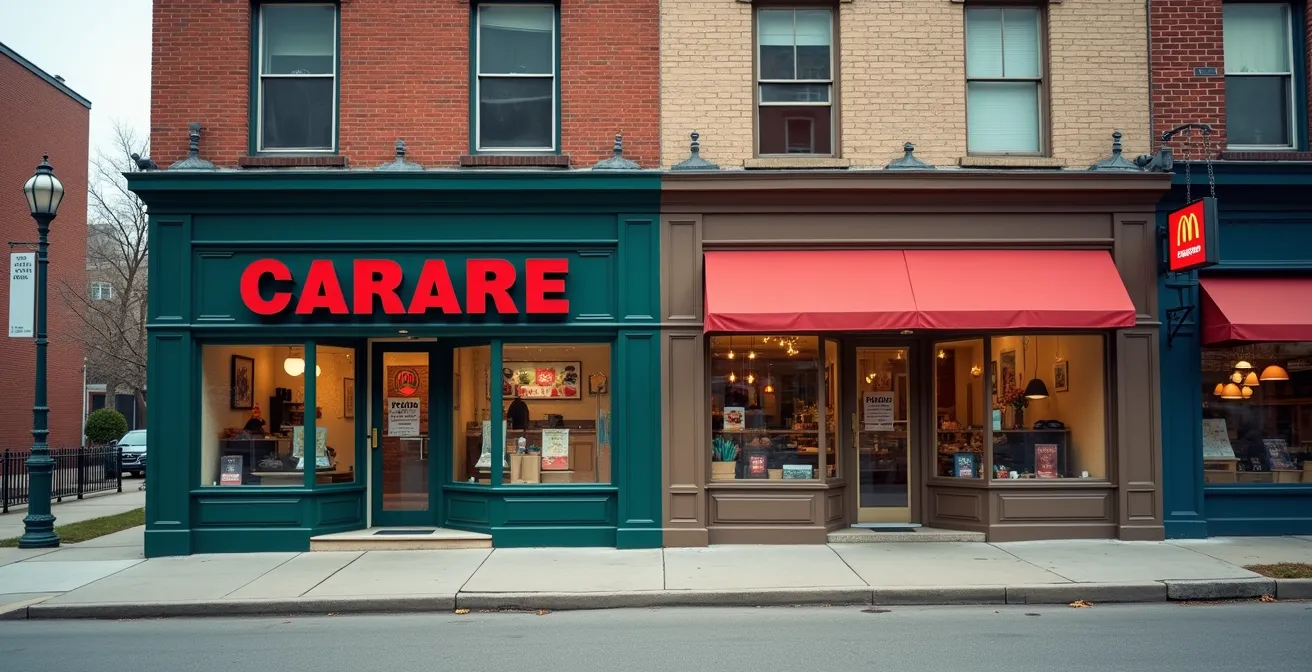
Most brands fight inconsistency; the best ones fight brand entropy—the silent, inevitable decay of visual standards that erodes value over time.
- Outdated visuals aren’t just unappealing; they create a “perceptual rift” that drives customers away and legally weakens your trademark.
- A proactive, data-driven refresh cycle is more cost-effective and strategically sound than reactive, piecemeal fixes.
Recommendation: Shift from policing franchisees to equipping them with tiered rollout plans and locked-down design tools to protect brand equity as a shared asset.
As a brand director, you know the feeling. You drive past one of your own locations and your heart sinks. The sign is faded, the colors are from a decade ago, and a makeshift promotional banner is taped to the window. It’s a moment where the brand you painstakingly protect at a corporate level collides with a jarringly different reality on the ground. This gap is the perceptual rift, the space where customer trust and brand equity go to die. We’re often told the solution is a better brand guide or more templates, but these are merely tools, not a strategy.
These measures fail because they don’t address the root cause: brand entropy. Like any system, a brand’s visual identity naturally degrades over time without constant, strategic energy put into maintaining it. Each outdated location, each piece of DIY marketing, isn’t just a minor infraction; it’s a symptom of this decay. It actively erodes the premium customers are willing to pay, the trust they place in your name, and even the legal ground you stand on to defend your trademark. The challenge, especially in an aging network, is not just to enforce rules but to reverse this entropy.
But what if the key wasn’t simply about stricter enforcement, but about a more intelligent, protective strategy? What if you could diagnose the financial impact of visual decay, build an undeniable business case for refurbishment, and empower franchisees to become guardians of the brand alongside you? This isn’t about control for control’s sake; it’s about protecting a shared, high-value asset from inevitable erosion.
This guide provides a strategic framework for you, the brand director, to move beyond policing and into active preservation. We will explore how to quantify the cost of inaction, budget for renewal without crippling cash flow, and establish clear operational guardrails that make consistency the path of least resistance. It’s time to stop patching the cracks and start reinforcing the foundation.
Summary: A Brand Director’s Playbook for Curing Visual Decay
- Why Customers Walk Away When Your Signage Looks 10 Years Old?
- How to Budget for a Mandatory Refurbishment Without Killing Cash Flow?
- Corporate Templates or Canva: What Are You Allowed to Design Yourself?
- The DIY Disaster: Why Homemade Signage Can Void Your Franchise Agreement?
- When to Refresh the Look: Every 5 Years or When Competitors Move?
- Reliability or Flash: What Builds More Equity in a Service Business?
- How to Use the Brand Name Without Violating Strict Trademark Guidelines?
- Operational Consistency: How to Eliminate the “Bad Day” Factor in Your Network?
Why Customers Walk Away When Your Signage Looks 10 Years Old?
An outdated sign is not a passive object; it’s an active statement. It tells a potential customer, “We don’t invest in ourselves, so why should you invest in us?” This creates a perceptual rift between the modern, dynamic brand you promise in national campaigns and the tired, neglected experience they encounter locally. This inconsistency is a primary driver of equity erosion. Customers don’t differentiate between corporate and a franchisee; they see one brand, and a poor experience at any touchpoint taints the whole. The stakes are incredibly high in our hyper-connected world.
While data on signage-specific boycotts is scarce, the principle is clear: customers punish brands for poor experiences. For a brand like Burger King, its instantly recognizable logo, colors, and messaging are a promise of a consistent product. This visual handshake ensures that whether a customer is in Toledo or Tokyo, the experience is familiar and reliable. This is the antithesis of visual decay. When your locations fail to uphold this visual promise, you are not just looking dated; you are actively breaking a promise to the customer before they even walk in the door.
To fight this, you must quantify the “walk away” factor. Start tracking foot traffic and sales figures against the date of the last refurbishment for each location. Analyze online reviews for mentions of “outdated,” “dirty,” or “old” ambiance. By comparing the performance of recently refreshed locations to those suffering from visual decay, you can build a powerful, data-backed narrative. This isn’t about aesthetics; it’s about demonstrating how a 10-year-old sign directly contributes to a measurable decline in revenue and customer loyalty.
Ultimately, the customer’s perception is your brand’s reality. Letting visual standards slide is a silent invitation for them to walk away and find a competitor whose appearance matches their promise.
How to Budget for a Mandatory Refurbishment Without Killing Cash Flow?
The decision to mandate a network-wide refurbishment is strategically sound but financially daunting. For marketing and development departments, the numbers are already significant, with the average franchise budget projected to surpass $1 million. Announcing a compulsory, multi-million dollar refresh plan can feel like an attack on franchisee cash flow. The key to success is not a top-down decree but a collaborative, strategic rollout. You must present it as a co-investment in future profitability, not a punitive cost.
The most effective method is to abandon the “all-at-once” approach in favor of a tiered, data-driven prioritization. Not all locations are created equal in terms of their impact on brand perception. A flagship store in a major metro area has a much larger “brand blast radius” than a small regional outlet. A tiered rollout allows you to allocate capital where it will generate the most immediate visual and financial return, proving the concept’s ROI to the rest of the network.
This matrix helps transform a massive, intimidating expenditure into a manageable, phased project. By focusing the initial 40% of the budget on the most visible and severely degraded locations, you generate quick wins that build momentum and confidence across the network.
| Priority Tier | Visibility Score | Degradation Score | Timeline | Budget Allocation |
|---|---|---|---|---|
| Tier 1 – Critical | Flagship/High-traffic | Severe (8-10 years) | Immediate (0-3 months) | 40% of total budget |
| Tier 2 – High | Medium visibility | Moderate (5-7 years) | Short-term (3-6 months) | 35% of total budget |
| Tier 3 – Standard | Local/Low-traffic | Minor (3-4 years) | Long-term (6-12 months) | 25% of total budget |
This approach reframes the conversation from “how much will this cost me?” to “when will my location get its turn to increase its value?” It makes the brand director a strategic partner in growth, not just an enforcer of rules.
Corporate Templates or Canva: What Are You Allowed to Design Yourself?
The tension between brand control and franchisee creativity is a classic battleground. In the fight against brand entropy, giving franchisees unchecked freedom to design their own materials is a recipe for disaster. However, a rigid, top-down approach can stifle the local marketing agility needed to connect with a community. The solution lies not in choosing one over the other, but in establishing a “Core vs. Flex” framework. You must define what is sacred and what can be adapted.
The core elements are non-negotiable. These are the pillars of your brand’s identity: the precise logo usage, the approved font library, the primary color palette, and the overall tone of voice. These must be locked down. The flexible elements are where franchisees can have a “guarded sandbox” to play in. This typically includes local promotions, community event flyers, or seasonal campaigns where a local touch is beneficial. The key is that this flexibility is exercised within corporate-approved templates.

As this visual metaphor suggests, the choice of tools dictates the level of risk. Unrestricted access to professional design software for a franchisee is high risk, while tools like Canva Pro, when used with its Brand Kit feature, can be a powerful ally. A franchisor can create and lock templates, ensuring that any design a franchisee produces automatically uses the correct logos, fonts, and colors. This provides creative freedom within unbreakable guardrails, protecting brand integrity while empowering local marketing efforts. It’s the perfect synthesis of central control and local agility.
By clearly defining what parts of the brand are untouchable and providing the right tools for adaptation, you transform franchisees from potential liabilities into creative brand ambassadors.
The DIY Disaster: Why Homemade Signage Can Void Your Franchise Agreement?
When a franchisee hangs a homemade sign, it’s more than just an aesthetic offense; it’s a direct challenge to the legal foundation of the entire franchise system. From a brand director’s protective standpoint, this is where brand entropy becomes an existential threat. The value of your brand is intrinsically linked to its trademark, and trademark law requires active, consistent enforcement. Failure to police the use of your mark can lead to a catastrophic legal outcome: defensibility dilution.
This isn’t hyperbole; it’s a legal reality. Allowing one franchisee to use a non-compliant sign sets a precedent. If you later need to take legal action against a third-party infringer, they can point to your network’s inconsistency as proof that you haven’t been diligently protecting your mark. As legal experts warn, this can severely weaken your case. The Reidel Law Firm offers a stark analysis on this point:
Allowing one franchisee to use a non-compliant sign can weaken the parent company’s ability to defend its trademark against all other infringers, jeopardizing the entire brand.
– Reidel Law Firm, Legal analysis of franchise trademark protection
The “DIY disaster” often stems from a franchisee’s attempt to cut costs. As industry compliance programs have shown, franchisees looking for the most affordable option often turn to low-cost providers who lack the expertise or commitment to uphold strict brand guidelines. They may inadvertently modify logos or use incorrect colors, leading to the exact kind of inconsistency that confuses customers and, more dangerously, dilutes brand value and legal standing. What starts as a simple cost-saving measure can spiral into a brand-wide liability, potentially even putting the franchisee in breach of their agreement.
Therefore, enforcing signage standards is not about being a design critic. It is a fundamental act of protecting the brand’s most valuable legal and financial asset for the benefit of the entire network.
When to Refresh the Look: Every 5 Years or When Competitors Move?
Waiting for a competitor to open a sleek, new location next door before you consider a refresh is a losing strategy. That’s a reactive posture, and by then, the damage to your local brand perception is already done. The most resilient and valuable brands combat brand entropy proactively. They don’t wait for the ship to take on water; they schedule regular maintenance. The question isn’t *if* you should refresh, but on what cycle.
While a “five-year rule” is a common benchmark, the optimal cadence is dictated by data, not just the calendar. The world’s leading brands are in a state of constant, subtle evolution. In fact, research shows that nearly 74% of S&P 100 companies have rebranded within their first seven years of existence. This demonstrates a clear understanding that visual relevance is not permanent. They are actively managing their brand’s lifecycle, ensuring it never appears stagnant or out of touch with the current market.

As a brand director, your role is to be the forward-looking strategist, not the reactive firefighter. This means establishing a dashboard of brand health indicators to monitor the vital signs of your brand’s perceptual relevance. When these metrics begin to trend downward, it’s a clear signal that a refresh is needed, long before a competitor’s grand opening forces your hand. This data-driven approach transforms the decision from a subjective debate into a strategic imperative.
Your Action Plan: Brand Health Dashboard Indicators to Monitor
- Monitor social media sentiment scores monthly using brand monitoring tools.
- Track share of voice against your top 3 competitors on a quarterly basis.
- Analyze customer feedback scores, focusing specifically on brand perception metrics.
- Document competitive brand launches and refresh announcements in your market.
- Measure brand recall and recognition through annual customer surveys to spot decay.
By adopting a proactive, data-informed refresh cycle, you ensure the brand remains a powerful, relevant asset rather than a slowly degrading liability.
Reliability or Flash: What Builds More Equity in a Service Business?
In a service-based franchise, the debate often surfaces: what matters more for long-term brand equity? Is it the “flash”—the sleek, modern, visually consistent environment—or the “reliability” of exceptional, repeatable service? Many assume they are separate pursuits, but the truth is that they are two sides of the same coin. One without the other is a missed opportunity; together, they create an exponential effect on brand value.
Reliability is the bedrock of trust. It’s the promise that the service delivered today will be the same quality as the service delivered tomorrow. This is the core of the franchise model. However, flash—or what we should call strategic visual standards—is the powerful first impression that sets customer expectations. A clean, modern, and professional-looking environment signals that the service to come will also be of high quality. It creates a “halo effect” where the positive visual experience elevates the perception of the service itself. In fact, research from Marq shows that 68% of businesses reported that brand consistency contributed 10-20% of their revenue growth, proving this synergy is not just theoretical.
The relationship between these two elements is not additive; it’s multiplicative. As the framework below illustrates, while both build equity independently, their combined effect is far greater. A visually appealing location can justify a small price premium, but a reliable one can justify more. A location that is both visually impressive and consistently reliable can command the highest premium and earns the fiercest loyalty.
| Element | Flash (Visual Impact) | Reliability (Service Quality) | Combined Effect |
|---|---|---|---|
| Customer Trust | Creates immediate positive impression | Builds through consistent delivery | Halo effect amplifies perception |
| Price Justification | +5-10% premium acceptance | +10-15% for proven track record | +20-30% when synchronized |
| Customer Retention | Attracts new customers | Keeps existing customers | Creates brand advocates |
| Recovery from Issues | Limited buffer | Strong forgiveness factor | Maximum resilience |
Ultimately, flash gets them in the door, but reliability keeps them coming back. A successful brand director ensures both are working in perfect harmony.
How to Use the Brand Name Without Violating Strict Trademark Guidelines?
Protecting the brand’s name and logo is not an art; it’s a science of precision. Every time the logo is used, it must be a perfect replication of the corporate standard. There is no room for interpretation or creative license. The brand’s visual mark is its most concentrated form of equity, and its use must be governed by rigid, unassailable rules. This is the frontline in the war against brand entropy.
The most critical concept to enforce is the “safe zone” or “clear space” around the logo. This is a non-negotiable area that must remain free of any other text, graphics, or distracting elements. It gives the logo breathing room and ensures its integrity is never compromised. Similarly, the logo’s proportions, colors, and orientation are sacred. It should never be stretched, squashed, recolored, or altered in any way. Providing franchisees with a centralized digital asset library containing only approved logo files is the first and most important step in preventing violations.
To ensure absolute clarity and eliminate any ambiguity for franchisees, your brand guidelines must be explicit. There is no such thing as being “too specific” when it comes to trademark protection. The following rules should be considered the absolute minimum standard:
- DO: Use approved logo files from the centralized brand asset library exclusively.
- DO: Maintain a minimum clear space (often defined by a key element of the logo, like the x-height of the text) around all sides.
- DON’T: Stretch, squash, rotate, or distort the logo in any way.
- DON’T: Place the logo on busy or patterned backgrounds that compromise its visibility and legibility.
- DON’T: Create unofficial variations or add unapproved effects like drop shadows, glows, or outlines.
- DO: Submit all co-branded materials for corporate approval before any production or publication.
Treating the logo and brand name with this level of disciplined respect is the ultimate act of brand protection. It ensures the mark remains a strong, clear, and legally defensible symbol of your company’s value.
Key Takeaways
- Brand entropy is a constant threat; visual decay is its primary symptom and actively erodes brand equity and customer trust.
- Proactive, data-driven refurbishment using tiered rollout plans is a strategic investment in future profitability, not just a maintenance cost.
- Enforcing visual standards is not merely about aesthetics; it is a legal necessity to protect your trademark’s defensibility against infringers.
Operational Consistency: How to Eliminate the “Bad Day” Factor in Your Network?
A brand is not just what customers see; it’s what they experience. While visual uniformity creates the promise, operational consistency delivers on it. You can have the most beautiful, perfectly on-brand location in the world, but if a customer has a “bad day” experience due to poor service or an inconsistent product, the visual investment is wasted. Eliminating this “bad day” factor is the final frontier in creating a truly resilient brand.
This is where visual and operational standards merge. A well-organized, clean, and visually compliant workspace is often a precursor to an operationally efficient one. Systems, processes, and standards are the antidote to inconsistency. As the Subway case study illustrates, operational excellence is built on a foundation of clear, simple, and relentlessly communicated core values: exceptional service, high-quality menu items, and efficient systems. These values are the operational equivalent of a brand’s logo and color palette—they are the DNA of the customer experience.
As a brand director, your influence extends here. By championing systems that ensure consistency—from employee training modules to standardized scripts to quality control checklists—you are protecting the brand’s experiential promise. You are helping to ensure that the “bad day,” an outlier caused by human error or a lack of process, becomes an extreme rarity rather than an unfortunate possibility. This creates a brand that customers don’t just recognize, but one they can reliably trust, time and time again. The ultimate goal is to make the “good day” the only day a customer ever experiences.
Your brand is a living asset, defined by every customer interaction. The next logical step is to move from reactive policing to proactive protection. Begin by auditing your network for both visual and operational decay, and build the undeniable business case for a strategic, holistic refresh program.
Frequently Asked Questions on Franchise Brand Uniformity
What brand elements are absolutely non-negotiable?
Logo usage, the approved font library, primary color combinations, copy tone and voice, and the style of imagery are the core non-negotiable elements. These must remain consistent across all franchise locations to protect the brand’s core identity.
Where can franchisees have creative flexibility?
Franchisees can typically exercise creative flexibility on local promotions, community event flyers, and seasonal campaigns. However, this should always be done using corporate-approved templates that maintain brand guidelines for fonts, colors, and overall visual identity.
How can Canva Pro help maintain brand consistency?
Canva Pro’s Brand Kit feature allows franchisors to create and lock templates with corporate brand assets. This provides franchisees with creative freedom within unbreakable guardrails, ensuring that all local marketing materials automatically adhere to brand standards and protect brand integrity.