
Building deep, local brand equity is the single most effective strategy for a franchisee to command a premium sale price.
- Financial value is driven by intangible assets like community trust and reliability, not just the parent company’s national marketing.
- Becoming a “Community Mayor” through hyper-local partnerships and authentic engagement creates a “reputation moat” that insulates your business from competition and crises.
Recommendation: Shift your focus from generic promotion to co-creating value with your community; this codifies your brand’s goodwill into a tangible, sellable asset.
As a franchisee, you operate under a powerful national banner, benefiting from its recognition and marketing muscle. It’s a significant head start. Yet, when the time comes to sell, you may find that the valuation of your business doesn’t reflect the years of hard work you’ve invested. Many owners focus on operational efficiency and adhering to corporate guidelines, believing this is the path to value. They sponsor a local team, run the prescribed ads, and assume the national brand will do the heavy lifting. But what if the key to unlocking a premium sale price lies not in being a perfect replica, but in becoming an irreplaceable part of your local community?
The real valuation multiplier isn’t found in the franchise agreement; it’s built in the streets, schools, and social fabric of your town. This guide moves beyond the platitudes of local marketing. We won’t just tell you to “get good reviews” or “run Facebook ads.” Instead, we will explore a more profound strategy: how to transform your franchise location from a generic outpost into the recognized “Community Mayor.” This means building a reputation so strong and a connection so deep that your business becomes a local institution. It’s about creating an intangible asset—a “reputation moat”—that a potential buyer can’t replicate and is willing to pay a premium for.
We will deconstruct how to translate this community standing into measurable financial value. We’ll show you how to adapt national campaigns to create local resonance, build unshakeable trust through reliability, and turn potential PR nightmares into loyalty-building opportunities. By the end of this article, you will have a clear roadmap for building a brand asset that not only thrives today but commands a top-dollar valuation tomorrow.
This article provides a comprehensive framework for transforming your franchise into a high-value local asset. The following sections will guide you through the core strategies, from understanding the financial impact of your brand to mastering community engagement and reputation management.
Summary: Brand Equity: How to Become the “Mayor” of Your Local Market?
- Why a Strong Local Brand Sells for a Higher Multiple than a Generic One?
- How to Adapt National TV Ads for Your Local Facebook Audience?
- Reliability or Flash: What Builds More Equity in a Service Business?
- The PR Nightmare: How One Bad Interaction Can Tarnish the Whole Network
- How to Partner with Schools and Charities to Build Deep Trust?
- Why Franchising Your Business Can Triple Brand Valuation in 3 Years?
- Why Customers Walk Away When Your Signage Looks 10 Years Old?
- Review Management: How to Turn a 1-Star Rant into a 5-Star Loyalty Win?
Why a Strong Local Brand Sells for a Higher Multiple than a Generic One?
When an acquirer evaluates your franchise, they aren’t just buying your equipment and inventory; they are buying your future cash flow. A generic, interchangeable location offers a predictable but limited return. A location with powerful local brand equity, however, offers something far more valuable: a durable, loyal customer base that is less price-sensitive and more resilient to competition. This is the “reputation moat” that justifies a higher valuation multiple. It’s the difference between buying a business and buying a beloved local institution.
This isn’t just a theoretical concept; it has a massive financial impact. Intangible assets like brand perception are a primary driver of overall business worth. In fact, a recent WIPO analysis reveals that the global value of the world’s top brands grew by almost 6 percent in a single year, reaching over $14 trillion. For a franchisee, this means the goodwill you build is a real, appreciating asset. Stanford research on Samsung, for example, found the company earned $127 million per year from brand equity alone. The study highlighted that simple awareness and brand cachet—purely intangible factors—were the largest components driving this financial return.
Think of it from a buyer’s perspective. They see that your customers don’t just come for the product; they come for your specific location. They come because of the trust you’ve built, the familiar faces you employ, and the sense of community you foster. This loyalty is a powerful de-risking factor. It signals a stable revenue stream and reduces the marketing costs the new owner will have to incur. Your status as a “Community Mayor” isn’t just a feel-good title; it’s a quantifiable valuation multiplier that proves your business is more than the sum of its parts.
How to Adapt National TV Ads for Your Local Facebook Audience?
The parent company provides polished, high-budget national advertisements designed for broad appeal. While powerful, these ads often lack the one thing that builds true local equity: authenticity. Simply running the corporate TV spot on your local Facebook page is a missed opportunity. Your mission as a “Community Mayor” is to achieve local resonance, translating the national brand’s themes into content that feels personal and relevant to your specific neighborhood.
This doesn’t require a Hollywood budget. The key is to add a human layer to the corporate message. Instead of just sharing the national ad, create a short, personal “brand story” video. Give customers a peek behind the curtain, introducing yourself as the owner and sharing why you are passionate about serving this community. This humanizes the brand and builds a direct connection with you, the franchisee. You can use simple tools to achieve this; a modern smartphone, a basic tripod, and good natural light are often all that’s needed to create compelling, authentic content.
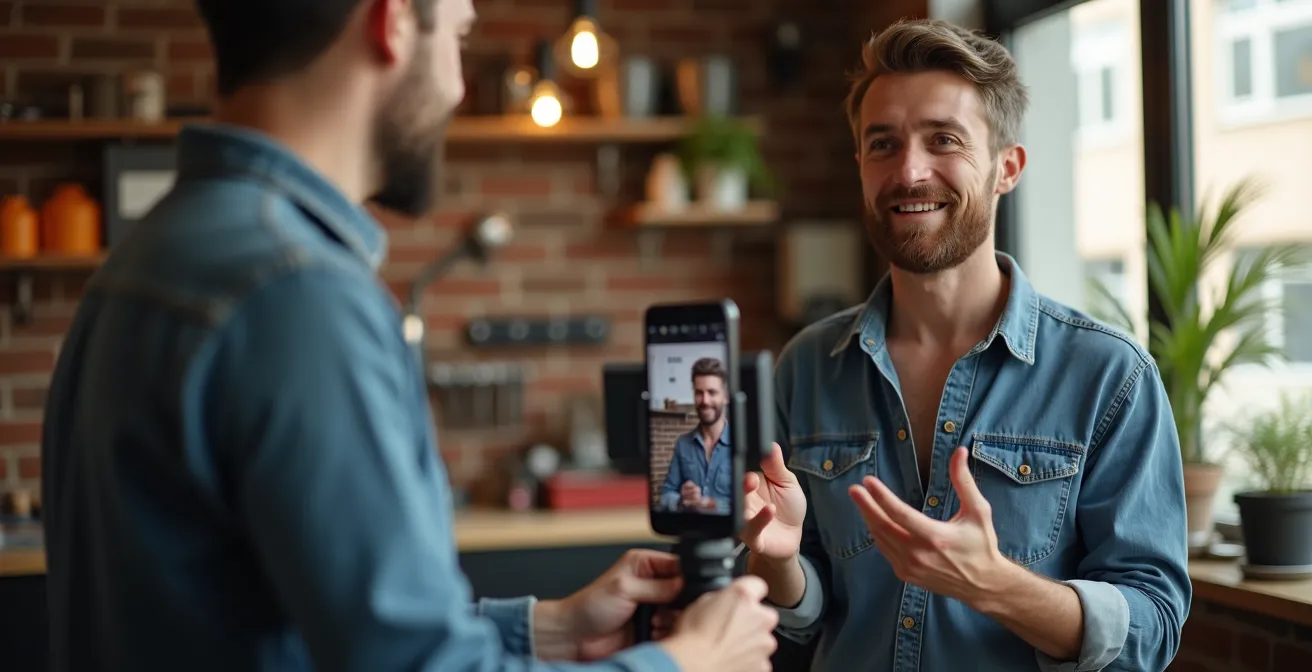
As you can see, the focus is on authenticity, not slick production. From there, you can get more creative. Use Facebook’s micro-targeting to create cheap ad variations with copy tailored to specific neighborhoods. Feature local landmarks or mention community inside jokes in your visuals. Partner with recognizable local figures—not expensive influencers, but the leader of a community group or a well-liked teacher—for a quick endorsement. The goal is to make your audience feel that the national brand is speaking directly to them, through you. This transforms a generic message into a meaningful local conversation.
Reliability or Flash: What Builds More Equity in a Service Business?
In the quest to build brand equity, franchisees often face a strategic choice: should we invest in “flash”—eye-catching marketing, trendy promotions, and a cutting-edge image—or in “reliability”—consistent service, operational excellence, and predictable quality? While flashy tactics can generate short-term buzz, sustainable brand value, especially in a service business, is overwhelmingly built on a foundation of trust. Reliability is the bedrock of your “reputation moat.”
Flashy campaigns attract transactional customers; reliability cultivates loyal advocates. A customer drawn in by a deep discount may leave just as quickly for the next big offer. A customer who knows they can count on you for flawless service, every single time, becomes an annuity. They are more forgiving during a crisis, more likely to recommend you to friends, and less sensitive to price increases. As V. ‘Seenu’ Srinivasan of the Stanford Graduate School of Business notes, brand image is a powerful driver, but it must be backed by substance. He states:
This means that a brand’s ‘image’ provides a stronger incentive for buying even than the perception that it is a better product. But greater awareness of your brand is the major component driving brand equity.
– V. ‘Seenu’ Srinivasan, Stanford Graduate School of Business
This highlights that while image (flash) matters, it’s the deep-seated awareness and trust (reliability) that form the core of equity. A hybrid approach is often optimal, using moments of flash to highlight your underlying reliability. The data below shows how these strategies impact key business metrics. As demonstrated by comparative industry analysis, a focus on reliability yields steadier, more resilient growth.
| Aspect | Reliability-Focused Strategy | Flash-Focused Strategy | Hybrid Approach |
|---|---|---|---|
| Brand Value Growth | Steady 3-5% annually | Volatile 10-15% spikes | Consistent 6-8% growth |
| Customer Retention | 85-90% retention rate | 60-70% retention rate | 80-85% retention rate |
| Price Premium Ability | 15-20% above market | 5-10% above market | 20-25% above market |
The PR Nightmare: How One Bad Interaction Can Tarnish the Whole Network
Your “reputation moat” is your greatest asset, but it’s not invincible. In today’s hyper-connected world, a single negative experience—a rude employee, a botched service, a poorly handled complaint—can spread through the local community like ripples in a pond, causing disproportionate damage. This is the franchisee’s paradox: you benefit from the national brand’s strength, but you are also vulnerable to how your actions reflect upon it. A local PR nightmare doesn’t just hurt your store; it can tarnish the perception of the entire network in your area.

The financial stakes are incredibly high. A single negative incident, amplified on social media or local news, can quickly erode years of trust. As the image above illustrates, what starts as one small drop can expand to affect the entire community’s perception. The impact is direct and measurable; Status Labs research demonstrates that businesses with just one negative article ranking online risk losing over 20% of their prospective customers. If that number grows to four or more, potential losses can soar to 70%. For a franchisee, this translates directly into lost revenue and a devalued asset.
Consider the cautionary tale of Delta Airlines’ 2024 systems failure. A single operational breakdown cascaded into over 7,000 canceled flights and an estimated $550 million in losses in just one week. While your franchise operates on a different scale, the principle is the same: one failure point can trigger a full-blown brand crisis. This underscores the need for proactive crisis management protocols and transparent communication strategies. Being a “Community Mayor” means not only building goodwill during the good times but also having a plan to protect it when things go wrong.
How to Partner with Schools and Charities to Build Deep Trust?
Many franchisees approach community involvement with a checkbook, sponsoring a local event or sports team and calling it a day. While well-intentioned, this passive sponsorship rarely builds the deep, authentic trust that defines a “Community Mayor.” To construct a formidable “reputation moat,” you must shift from being a sponsor to being a partner. This means moving from simply writing checks to actively co-creating value with community organizations like schools and charities.
The difference is profound. A sponsor is an advertiser; a partner is a collaborator. True partnership involves leveraging your unique business expertise to help a local cause. For example, a restaurant franchisee could partner with a school’s culinary program to mentor students. A tech service franchisee could offer free workshops at the local library. This approach is exemplified by Salesforce’s “1-1-1” model, where they dedicate a portion of their equity, products, and employee time to charitable causes. This isn’t an add-on; it’s integrated into their core business model, generating genuine engagement and external trust.
To implement this effectively, focus on hyper-local initiatives. Instead of a city-wide sponsorship, partner with a single classroom or a small neighborhood charity where your impact can be deeply felt and seen. Empower your employees to choose and lead these initiatives, as their genuine passion will be far more compelling than any top-down corporate mandate. By documenting these activities and sharing them transparently, you’re not just doing good; you’re building a powerful, authentic narrative about your brand’s commitment to the community. This is how you transform goodwill into a documented, sellable asset.
Your Action Plan: Framework for School and Charity Partnerships
- Shift from passive check-writing to actively co-creating programs that leverage your unique expertise.
- Let employees choose and lead charitable initiatives for authentic engagement and morale.
- Focus on hyper-local partnerships (like a single school classroom) for deeper, more visible impact.
- Create measurable mutual benefits (e.g., skills for students, positive exposure for you) to ensure the partnership is sustainable.
- Document partnership activities through authentic video and social content for transparency and storytelling.
Why Franchising Your Business Can Triple Brand Valuation in 3 Years?
For an independent business owner, the decision to franchise is a monumental step, but it’s also one of the most powerful ways to codify and multiply brand value. When you franchise your business, you are forced to do something crucial: you must distill your “secret sauce”—your processes, your culture, your customer service philosophy—into a replicable system. This act of asset codification transforms your implicit brand knowledge into a tangible, transferable asset, dramatically increasing your enterprise value.
The very first successful franchise unit serves as definitive proof of concept. It demonstrates to potential acquirers that your brand is not just a one-off success tied to your personal efforts, but a scalable system poised for growth. This is the single most important factor for buyers looking to expand, and it can have a staggering effect on valuation. The willingness of an entrepreneur to pay a significant franchise fee provides hard, quantifiable proof of your brand’s intangible value. It’s a market-validated data point that says your brand is worth investing in.
This shift is reflected directly in valuation multiples. Acquirers pay more for predictable, scalable growth. According to industry valuation data, franchise-heavy industries can command significantly higher EBITDA multiples. For example, sectors like signs and advertising can see multiples near 12x, while successful franchise operations can often secure multiples 2-3 times higher than comparable single-location businesses. For a founder, this means that successfully launching even one or two franchise locations can effectively double or triple your brand’s valuation in as little as three years, turning your local success into a high-value, scalable enterprise.
Why Customers Walk Away When Your Signage Looks 10 Years Old?
Your physical location is the most tangible manifestation of your brand. In an age where customers research online before visiting, a jarring disconnect between your modern digital presence and an outdated physical storefront can be fatal to your credibility. Imagine a customer impressed by your sleek website and active social media, only to arrive at your location and see a faded, cracked, or simply old-fashioned sign. That moment of dissonance instantly shatters their perception of your brand.
This isn’t just an aesthetic issue; it’s a direct assault on your brand equity. Outdated signage communicates neglect. It suggests that if you don’t care about your appearance, you probably don’t care about your product quality or service standards either. Before they even step inside, the customer has mentally positioned you as inferior to competitors with cohesive, modern visual branding. This visual betrayal creates a powerful negative bias that is difficult to overcome. The trust you built online evaporates on the sidewalk.
Research confirms that maintaining visual consistency across all brand touchpoints—digital and physical—is non-negotiable. When your physical appearance fails to live up to the promise made by your online marketing, you create a brand integrity gap. Customers are savvy; they interpret this gap as a lack of professionalism or, worse, a sign that the business is struggling. They may not consciously analyze it, but the feeling is immediate: “This doesn’t feel right.” In a competitive market, that feeling is enough to make them turn around and walk away, taking their business to a competitor who presents a confident, consistent brand image from screen to street.
Key Takeaways
- Becoming a “Community Mayor” by building deep local trust is the most direct path to a higher franchise valuation.
- True brand equity is built on a foundation of reliability and authentic partnership, not just flashy marketing or passive sponsorship.
- Consistency is everything: your physical presence must match your digital promise to maintain credibility and trust.
Review Management: How to Turn a 1-Star Rant into a 5-Star Loyalty Win?
Online reviews are the modern-day word-of-mouth, and a single 1-star rant can feel like a direct attack on your business. However, for a “Community Mayor,” a negative review is not a crisis; it’s an opportunity. How you respond to public criticism is one of the most visible tests of your brand’s character. A thoughtful, empathetic, and effective public response can not only neutralize the negative comment but also transform a disgruntled customer into a loyal advocate and demonstrate your commitment to service for all to see.
The key is to execute the “Public Resolution Playbook.” First, respond quickly, ideally within 24-48 hours, to show you are listening. Begin your public reply not with excuses, but with empathy. Acknowledge the customer’s frustration and validate their feelings. Then, without getting defensive, briefly state how you are addressing the issue internally. This shows accountability. Whenever appropriate, offer a tangible resolution—a refund, a replacement, or an invitation to return for a better experience—and take the detailed conversation offline to resolve it personally.
Finally, and this is the step most businesses miss, follow up publicly after the issue is resolved. A simple comment like, “Hi [Customer Name], we’re so glad we were able to connect and resolve this for you. We look forward to seeing you again soon,” closes the loop and shows prospective customers that you follow through on your promises. This transparent process turns a negative review into a powerful public testament to your high service standards. It reinforces your brand values and builds a level of trust that a perfect 5-star record never could. You’re not just fixing a problem; you’re building your “reputation moat” in real-time.
By embracing these strategies, you shift from being a simple operator to a true brand-builder. You create a business that is not only profitable but has deep, defensible, and highly valuable roots in its community. To put these principles into action, start by assessing where your greatest opportunities for community integration lie.